2014-08-17

Deneke family photos

I have these photos (mostly of my mother's family) that I hope to identify with a date and subject. If you have corrections or additions for any information, please leave a comment on this page or contact me directly at tgkohn@aol.com.

The photos were scanned in groups, and the groups will be edited into separate photos eventually.

Image 1,
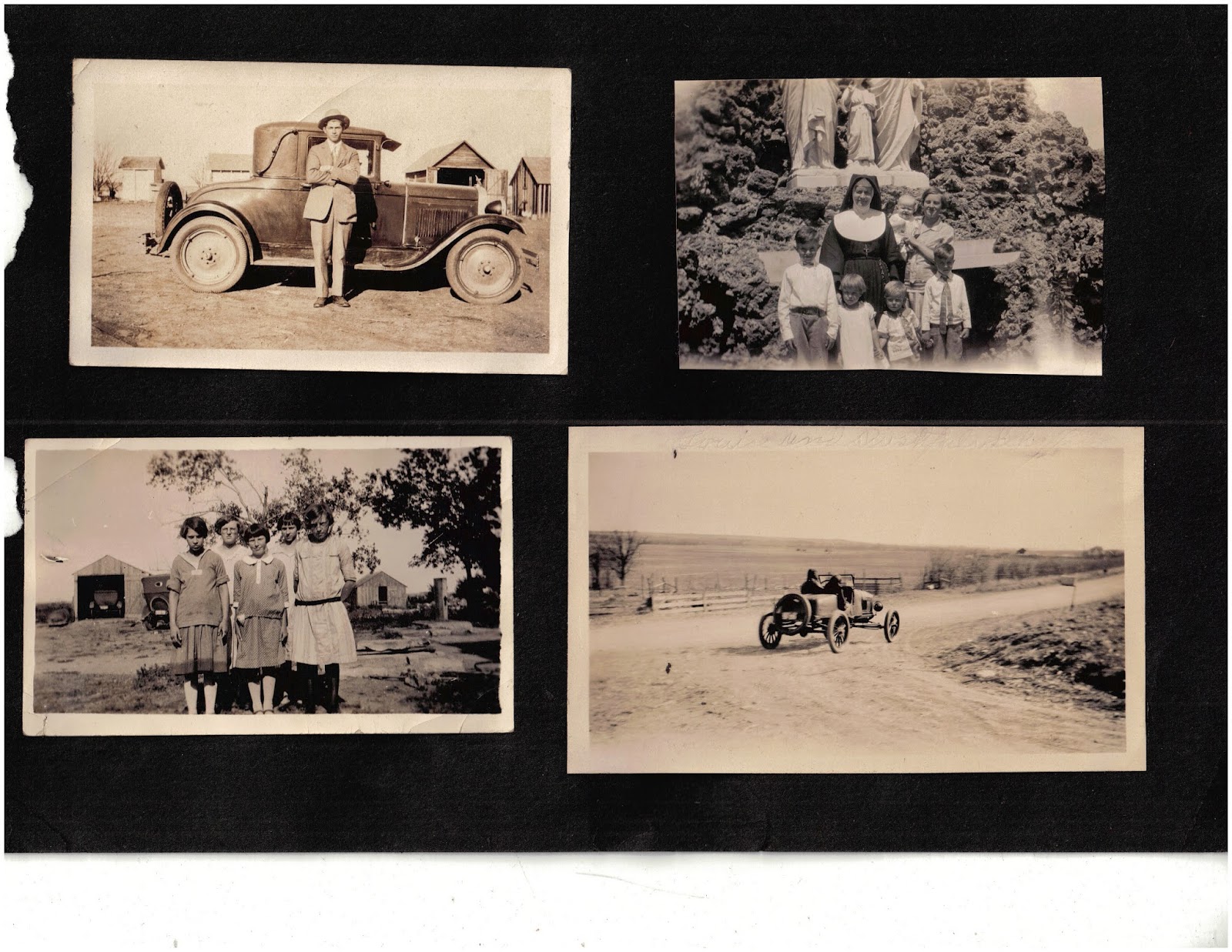
1. Henry Deneke (1878-1960) and his daughter Sr Henrita (Cecilia) Deneke (1915-2002), between 1947 and 1959 at my parents' farm near Ionia KS.


Image 2.
2. Unidentified sister of the Congregation of St. Joseph, likely at the cemetery altar of Nazareth Mothernouse, Concordia KS. Perhaps Sr. Romanus or Sr. Ursula? Cousin Katie M. (a daughter of William Clark) says, "#2 I am pretty sure is sister Ursula."


Images 3a and 3b,
3a. Louise Deneke (1913-1990) and Mathew Robert Kohn (1901-1971) marriage on 1947.02.13 in Beloit KS.

3b. Witnesses her brother Leo Francis Deneke (1919-1992) and her friend Margaret L Heger (full identity not known).


Image 3c.
3c. An alternate pose for their wedding portrait.


Images 4a and 4b,
4a. Louise Deneke-Kohn and Math Kohn, 1947.02.12 holding their wedding cake at the wedding reception. I believe that the stone house in the background is not from the Henry Deneke farm.

4b. Math Kohn in a long coat and suit, standing in front of a long porch attached to a brick building with many windows (a hotel or apartment house?). The back is noted, "Math." in my mother's hand.


5a. Nurse holding the infant James Kohn in a hospital setting. November or December 1948.

5b. Math Kohn and son Jimmy, perhaps March 1949.

5c. James Kohn at about 10 months (September 1949).

5d. Math Kohn, Louise Kohn holding Jimmy (about 15 months), and Sr. Henrita Deneke. About March 1950. They are standing outside the Math Kohn farm home. Who is the photographer?


Images 6a and 6b,
6a.

6b.


Images 7a, 7b, 7c, 7d, and 7e.
7a.

7b.

7c. Christmas crĂȘche.

7d. Marguerite Deneke and Math Kohn.

7e.


8 (no photo)

9 (no photo)

Images 10a, 10b, and 10c.
10a. Group of 10 women and 1 man, perhaps sisters of Saint Joseph celebrating their anniversaries; front left is Sr Mary Henrita Deneke age about 70. The photo back reads, "Class of 1945 Taken May 27, 1995. Top: 1. Rita Flynn Larsen, 2. Emily Shopp Schlenicke, 3. Florence Beatte Schlagecek, 4. Fred Mildrexler, 5. Ruth Boden Alkire, 6. Gage Vanous Hill, 7. Virginia Felt Nelson. Bottom: 1. Sr. Henrita, 2. Zula Preston Norink, 3. Eva Charbonneau Alexander, 4. JoAnn Brown, 5. Dorothy Snodgrass. Absent: 1. Norene Grimm Carter, 2. Pauline Kemp, 3. Margaret Scott Dalton, 4. Annette Gaydusk.

10b. Nazareth Motherhouse.

10c. Sr Mary Henrita (Cecilia) Deneke age about 30.


Images 11a and 11b,
11 Two children, about ages 2 years and 6 months. The card holder has "Schaeffer?" inscribed.


Images 12a and 12b,
12a. Boy age about 8 in white trousers, white shirt, black bow tie, and holding a rosary and small book. Likely a first communion photograph.

12b. Boy about age 8 in white suit and white sailor cap, holding a white tube or rolled diploma. Likely the same photo session as 12a. The card photo holder is marked "The Reflex Studio Beloit."


Images 13a and 13b,
13a. Woman with bright eyes and tightly curled hair, wearing a black gown with broad white collar and black satin bow, about age 22. The card photo holder is marked "Evelyn Butler" with no other identification. Evelyn Marie Butler (1922-?) was the fourth child of James Thomas Butler (1882-1939) and Grace Eugenia Dillon (1891-1960 est. dates). Evelyn was a first cousin to my mother and her siblings.

13b. Man with bright eyes and straight, thin hair, very faint moustache, wearing a woolen edge-trimmed three-piece suit, two-tone cravatte, and gold pocket watch on chain. The photo margin reads "Jean Honey, Art Studio, Beloit, Kans."

Image 14a.
14 Not yet certain if the photo (right) or the text on the reverse (below) holds genealogical information. Cousin Katie M. (a daughter of William Clark) says, "#14 I am sure is Dorothy Peterson, Gray."

Visible text below the photograph reads, "a former resident of Kansas City, Kansas, ...was announced today. ...married September 5 to Mr. Clarence Gray." Perhaps the photo is of Dorothy M Peterson (b. 1914.10.03), the daughter of Mary Forendo Clark (1893-1924) and Arthur Peterson and the grand daughter of Mary Ann Butler (1866-1939) and Ecles Leslie Joseph Clark (1868-1944).

The text on reverse lists members of several committees in the first story, announces the officiants of a Methodist church service in the second story, announces a meeting of the Bethany hospital guild in the third story, and announces a class meeting of the Central Christian church.
Image 14b. (reverse)


Images 15a and 15b,
15a. Marriage double portrait, about 1940. The back has the identification "Mary Hansen & Pete Braun 2nd wife" in my handwriting. Mary Agnes Deneke-Braun (1909-1936) was Pete Braun's first wife, who died in childbirth. His first marriage was 1931.08.12 at St. John the Baptist Catholic church in Beloit; his second marriage date and location unkown.

15b. Three boys in suits and a girl in a white dress, ages about 8 through 15, clothing that indicates a photo session around 1925. All wear over-the-ankle dress shoes. No identification.


Images 16a and 16b,
16a. Boy in a suit holding three cats. He is about age 10, and he looks to me much like Paul Deneke. He is seated on a wicker divan in a yard with a white picket fence. Outside the fence is a black propane tank. The photographer's shadow registers to the right of the boy. The reverse has a stamp, "Reflex Kodak Finishers Beloit, Kansas." Who is the photographer?

16b. Man and woman in Sunday best, likely mid-1920s, with a church in the background. I believe the church is Annunciation in Frankfort, Kansas. The reverse has the name "Mary" in an unknown hand and a stamp, "Reflex Kodak Finishers Beloit, Kansas." Theresia Maria Deneke (1891-1957) married Francis James Marksman (1875-1943) in 1917 at St. John the Baptist Catholic church in Beloit. They lived on a farm outside of Frankfort and raised a family of 9 children. I have no knowledge of a daughter named Mary, although their daughter Rosemary was born in 1921. Perhaps this is Francis' sister Mary Marksman.

Images 17a, 17b, and 17c.
17a. ?

17b. Back notation: "Mary Edgett." The couple is the same as in photo 16b.

17c. Same boy and setting as photo 16a, but the boy has his hands on two dogs. A pile of cut timber is in the far background. Who is the photographer?


Images 18a, 18b, and 18c.
18a. Photo notation: "Harold Deneke, Joe Deneke son." Harold R. Deneke (1920-1999) was born in the Beloit area and died in Washington OR. His parents are Joseph F. Deneke (1884-1945 or 1957) and Margaret E. Witt (estimated dates 1901-1975), who were married at St. John's in Beloit and moved to Mt. Angel OR.

18b.

18c. Photo notation: "Mary Edgett."


Images 19a, 19b, and 19c.
19a. Photo notation: "Pearl Whitaker Sweet" and studio mark "Leo Stern, 1118 Grand Ave., Kansas City MO."

19b. Photo notation: "Evelyn Butler. ...man Gale, York Aurora."

19c.


Images 20a, 20b, and 30c.
20a. Photo notation: "Aunt Sadie Butler."

20b. Photo notation: "James Clark, son of Wm J. Clark."

20c. Photo notation: "1-S. 1-E. 1-J. 1 of Uncle Jim Butler's girls" and studio mark "The Reflex Kodak Finishers, Beloit Kansas."


Images 21a, 21b, and 21c.
21


Images 22a and 22b,
22a. Photo notation: "Louise Kohn."

22b. Photo notation: "1. Joe Downey, 2., 3. Pete Deneke, 4. Aunt Ella Downy, 5. Henry (Grandpa Deneke), 6., 7., 8. Leo Deneke, 9." Who is the photographer?


Images 23a, 23b, and 23c.
23


Images 24a, 24b, and 24c.
24a. Louise Deneke at graduation from St. John High School.

24b. Leo Francis Deneke (1919-1992), date unknown, about age 20.

24c. Infant, unknown.


Images 25a and 25b,
25a.

25b.

Image 26a.


26a. Bound album cover. The photos can be dated to about Spring/Summer 1949, taken at the Kohn farm near Ionia KS. At that time, the ages of Pete and Nora's children were 8 (Cecelia Ann), 6 (Fred), 4 (Mary Lee), and 2 (Marguerite).

At most, only two of their children are shown in the same photo.

Who is the photographer?


Images 26b and 26c.
26b. James Kohn about age 8 months.

26c. Sr. Henrita (Cecilia) Deneke (1915-2002), about age 34.


Images 26d and 26e.
26d. Mary Lee Deneke (age 4, born 3 Jan 1945) standing beside her seated grandfather Henry Eugene Deneke (1878-1960) and, standing, aunts Louise Deneke-Kohn (1913-1990) and Sr. Henrita (Cecelia Genevieve) Deneke (1915-2002).

26e. Left to right: Nora Agatha Long-Deneke (1917-2005), James Robert Kohn (b. November 1947), Louise Josephine Deneke-Kohn (1913-1990), Mary Lee Deneke-Kadel (b. January 1945), Henry Eugene Deneke (1878-1960), Sr. Henrita (Cecelia Genevieve) Deneke (1915-2002), and Peter Bonface Deneke (1910-1971).

Images 26f and 26g.
26f. Partial exposure. Left to right: Louise Josephine Deneke-Kohn (1913-1990), James Robert Kohn (b. November 1947), Sr. Henrita (Cecelia Genevieve) Deneke (1915-2002), and Henry Eugene Deneke (1878-1960).

26g. Left to right: Peter Bonface Deneke (1910-1971), Nora Agatha Long-Deneke (1917-2005), James Robert Kohn (b. November 1947), Louise Josephine Deneke-Kohn (1913-1990), and Henry Eugene Deneke (1878-1960).


Images 26h and 26i.
26h. Left to right: Nora Agatha Long-Deneke (1917-2005), Cecelia Ann Deneke-Dean (b. 24 September 1940), James Robert Kohn (b. November 1947), Mary Lee Deneke-Kadel (b. January 1945), Louise Josephine Deneke-Kohn (1913-1990), Mary Lee Deneke-Kadel (b. January 1945), Henry Eugene Deneke (1878-1960), Sr. Henrita (Cecelia Genevieve) Deneke (1915-2002), and Peter Bonface Deneke (1910-1971).

26i. Medium shot, left to right: James Robert Kohn (b. November 1947), Sr. Henrita (Cecelia Genevieve) Deneke (1915-2002), Mary Lee Deneke-Kadel (b. January 1945).


Images 27a and 27b.
27a.

27b. Graduation class, 1932 St. John High School: Veronica Otter, Sr. Henrita (Cecelia Genevieve) Deneke (1915-2002), Gertrude Wendell, Loretta Rasher Lowry, Mildred Schaeffer, Agnes Krone, Bob Magette, and one unidentified woman and three unidentified men. First Communion class? of ten girls.


Images 28a and 28b.
28


Images 29a, 29b, and 29c.
29


Images 30a, 30b, 30c, and 30d.
30


Images 31a, 31b, and 31c.
31a.

31b.

31c.


Images 32a, 32b, and 32c.
32a.

32b.

32c.


Images 33a and 33b.
33


Images 34a and 34b.
34


Images 35a, 35b, 35c, and 35d.
35a. Louise

 35b.

35c.

35d. Kohn-Deneke wedding reception.


Images 36a and 36b.
36a.

36b. Seneca Hospital, where Sr. Henrita (Cecelia Genevieve) Deneke (1915-2002) worked.


Images 37a, 37b, and 37c.
37


Images 38a and 38b.
38


Images 39a, 39b, 39c, and 39d.
39a

39b. Louise

39c.

39d. Edgett-Marksman wedding? The couple is the same as in photos 16b and 17b.


Images 40a, 40b, 40c, and 40d.
40a. Sr. Henrita (Cecelia Genevieve) Deneke (1915-2002) in nursing uniform.

40b.

40c.

40d.


Images 41a, 41b, and 41c.
41a.

41b.

41c. Henry Eugene Deneke (1878-1960) and Sr. Henrita (Cecelia Genevieve) Deneke (1915-2002). Who is the photographer?


Images 42a and 42b,
42a.

42b. Henry Eugene Deneke (1878-1960), Louise, Tommy, Jimmy. Who is the photographer?


Image 43.
43


44 (no photo)


Images 45a and 45b,
45. Henry Deneke homestead photographed by Tom Kohn in 2002.

45a. House from the north.

45b. Barn from the west.


Images 46a and 46b,
46 Henry Deneke homestead photographed by Tom Kohn in 2002.

46a. House from the west.

46b. House from the northeast.


Images 47a and 47b,
47a. Sr. Henrita (Cecelia Genevieve) Deneke (1915-2002) and Louise, about 1925.

47b. Formal Family Portrait, 1938: front: Pete, Henry, Leo Francis Deneke (1919-1992); back: Louise, Sr. Henrita (Cecelia Genevieve) Deneke (1915-2002).


Images 48a and 48b,
48a. Photo notation: "Denekes of Oregon, One of Joe Deneke's." But who?

48b. Sr. Henrita (Cecelia Genevieve) Deneke (1915-2002) from the same 1938 photo session for the full family portrait (47a).


Images 49a and 49b,
49a. Henry Eugene Deneke (1878-1960) at graduation from St. Benedict's?

49b. Sr. Henrita (Cecelia Genevieve) Deneke (1915-2002) and Louise from the same 1938 photo session for the full family portrait (47a).


Images 50a and 50b,
50a. Photo notation: "Peter & Agnes Braun, 1939-1938." The date noted is incorrect, as Agnes died in 1936, and their marriage was 1931.08.12.

50b.


Image 51.
51. High school graduation portrait for Louise, about 1931 (seven men, five women). Louise is most left in the back row.


Image 52.
52. Leo Francis Deneke (1919-1992) and June Griffith-Deneke, formal wedding portrait, 1961.07.17.


Images 53a and 53b,
53. Photo notation: "Lizzie Pilcher" in left border, "Anna Butler" in right border, and in bottom border "Agnes Clark, Mary Clark, Kate Butler." Who is the photographer?

See details for Mary at photo 54a, Lizzie and Anna at photo 54b, and Kate in both 54a and 54b.

Agnes—Thresa Agnes—Clark (1900-1988) seems to be about age 12. Her age roughly corroborates the dating of photo 54a, which has many similarities in matting and color. Agnes married William Richard Prochaska (1897-1992) in the Glasco area on 1919.11.26. They lived in Cloud county and raised a family of four children: Harold William Prochaska (1920-2001), Maxine Marie Prochaska (1922-1924), Max Prochaska (1926-), and Neal Prochaska (1928-).


Images 54a and 54b.
54a. Photo notation, on front border: "Aunt Kate Bulter, Clarks from Glasco." Who is the photographer?

54b. Photo notation, on back: "Kate, Lizzie, Anna Butler." Who is the photographer?

Kate—full name Catherine B.—Butler (1870-1952) was the fifth child of Richard and Mary Ellen Butler. Kate was a Glasco teacher, postmaster, and housekeeper for the Catholic priest. She was born on the farm near Waunakee WI, moved with her parents to their farm west of Glasco, and lived in town and in Delphos KS when she became self-sufficient. By 1947 at age 77, she lived in Concordia.

The "Clarks from Glasco" must have included my mother's aunt Mary Ann Butler (1866-1939), her husband Ecles Leslie Joseph Clark (1868-1944), and several of their children: Mary Forendo Clark (1893-1924), William Richard Clark (1895-1967), Joseph Henry Clark (1897-1977), Thomas Francis Clark (1899-1965), Thresa Agnes Clark (1900-1988), Catherine Gertrude Clark (1903-1995), Margaret Ellen Clark (1906-1980?), and Julia Frances Clark (1908-1988). The photo includes Aunt Kate (back left), four women beside her in the back row, two young girls (middle row), and two boys (foreground). If Ecles Clark is the photographer, the full Clark family is missing one son. The youngest child appears to be about 7 years old, which might date the photo in 1915.

Lizzie—Elizabeth Gertrude—Butler (1885-1957) was the youngest child of Richard and Mary Ellen Butler. She married Hal Pilcher (1882-1953) on 1905.10.02 and had 15 children, of whom at least 3 died in infancy. and she raised the family in or near Delphos KS.

Anna—Anastasia L.—Butler (1875-1933) was the seventh child of Richard and Mary Ellen Butler. Anna was born on the farm near Waunakee WI, moved with her parents to their farm west of Glasco, and married Henry Deneke in Glasco KS on 1908.10.07.


Images 55a and 55b,
55a. Pete Deneke family dated January 1962. Front: Robert Dean, Cecelia Ann, Nora, Debbie Dean, Stanley, Pete; back: Paul, Rita, Marguerite, and Mary Lee. Actually taken Christmas Day, 1961?
Is Fred the photographer?

55b. Children on the Henry Deneke homestead. Photo notation on back: "Louise, Janita, Eva; Cecelia, Dorothea; Leo, Kenneth, Keith." The notation does not provide names the left-to-right order, so I can only guess that Leo Deneke is seated at the left end of the log, Louise is at the right end of the log, and Cecelia is third from the right. If I remember my mother's description, the other children are from neighboring farms. Who is the photographer?


Image 56.
56


Image 57.
57. Photo notation, "Sister Romanus, twin of Aunt Carrie." Anna (Sr. Romanus) Deneke (1887-1945). She entered the novitiate 1905.06.30 at Nazareth Motherhouse, Concordia KS, and professed her vows 1908.08.15. She was a primary and intermediate teacher in the schools of St. Peter, Schoenchen, Antonina, Aurora, St. Joseph, Herndon, Pfeifer, Cawker City, Tipton, and St. Mary's Academey, Silver City NM. I have two dates for her death: 1945.05.17 in El Paso TX or 1933.09.23 in Mitchell county. I believe the first date is more reliable. She is buried at Nazareth Motherhouse.


Image 58.
58. Photo notation: "Uncle George, Aunt Mary Dorsey,"in my hand—I was taking my mother's dictation. George Deneke (1877-1938) was my grandfather's eldestt brother, who married Mary Dorsey (1888?-1978) in the cathedral in Kansas City MO in 1915. My records show Arkansas as Mary's birth location. I believe they had no children, and I have no certain knowledge of exactly where they lived, althought they were in the 1920 census of Mitchell county. He is buried in Beloit. She resided in Ft. Smith AR at her death.

Note: It is possible that George Deneke is the father of Frank Deneke (1897-1968), who were raised as brothers. Family rumors cite Maria Rosa Deneke (1880-1935) as Frank's actual birth mother.


Images 59a and 59b,
59a. Louise

59b. ?


Images 60a and 60b,
60a. Sr. Henrita (Cecelia Genevieve) Deneke (1915-2002) from the same 1938 photo session for the full family portrait (47a)

60b. Louise?


Image 61.
61


62

63 


64


Images 65a, 65b, and 65c.
65a. Sr. Henrita (Cecelia Genevieve) Deneke (1915-2002)

65b. Louise?

65c. 


Images 66a and 66b,
Images 66a reverse and 66b reverse,
66a. Corner Courts Motel, owned by Leo Francis Deneke (1919-1992) and June.

66b. Funeral card, Mary Deneke.


67  (no photo)


Image 68.
68


Image 69.
69


Images 70a, 70b, and 70c.
70


Images 71a ...
71


Images 72a and 72b,
72
Images 72a reverse and 72b,


Images 73a ...
73


Images 74a, 74b, 74c, 74d, 74e, and 74f.
74


Images 75a, 75b, and 75c.
75


Images 76a, 76b, 76c, and 76d.
76


Images 77a, 77b, and 77c.
77


Images 78a, 78b, 78c, and 78d.
78


Images 79a and 79b,
79


Images 80a, 80b, and 80c.
80


Images 81a, 81b, 81c, and 81d.
81


Images 82a, 82b, and 82c.
82


Images 83a, 83b, 83c, and 83d.
83


Images 84a, 84b, 84c, and 84d.
84


Images 85a, 85b, 85c, and 85d.
85


Images 86a ...
86


Images 87a, 87b, and 87c.
87a. ?

87b. ?

87c. Leo Francis Deneke (1919-1992), Math, Louise, Henry Eugene Deneke (1878-1960). Children l-r: ??, Jimmy, Tommy (in arms).


Images 88a, 88b, 88c, and 88d.
88a.

88b.

88c. Sr. Henrita (Cecelia Genevieve) Deneke (1915-2002), Louise

88d.


Images 89a and 89b.
89a.

89b. Pete, Louise, Sr. Henrita (Cecelia Genevieve) Deneke (1915-2002), Leo Francis Deneke (1919-1992), and Agnes


Images 90a ...
90a. Edgett-Marksman wedding? The couple is the same as in photos 16b and 17b.


Images 91a, 91b, 91c, and 91d.
91a. Nora and Sr. Henrita (Cecelia Genevieve) Deneke (1915-2002).

91b. Louise and ?

91c.

91d.  Sr. Henrita (Cecelia Genevieve) Deneke (1915-2002) and her father Henry Eugene Deneke (1878-1960).


Images 92a, 92b, 92c, and 92d.
92


Images 93a ...
93a.

93b.

93c.

93d.

93e.

93f. Edgett-Marksman wedding? The couple is the same as in photos 16b and 17b.

93g.


Images 94a ...
94


Images 95a, 95b, 95c, and 95d.
95a.

95b.

95c. Four women.

95d. Roadster.


Images 96a, 96b, and 96c.
96a. Harvest time.

96b. Annunciation church in Frankfort KS?

96c. Unknown.


Images 97a, 97b, 97c, 97d, 97e, and 97f.
97a.

97b. Harvest

97c. Edgett-Marksman wedding? The couple is the same as in photos 16b and 17b.

97d.

97e.

97f.


Images 98a, 98b, and 98c.
98a. Two women.

98b. Three young women.

98c. Mixed group of adults.


Images 99a, 99b, 99c, 99d, 99e, and 99f.
99a. Three women

99b. Two women.

99c. Four women.

99d. Woman.

99e.Woman.

99f. Woman.

100


2014-06-22

1872 Routes from Caledonia MN to Tipton KS

Figure 1. Rivers and cities from Caledonia to Tipton
Original publication on 2013.10.30. Updated  2013.11.10 and 2014.06.21. © Thomas G. Kohn, 2014.

Katherine Reinert and her family of five children arrived in Tipton, Kansas after a trip of 600 miles or more from Caledonia, Minnesota. Although a family document asserts the travel was by wagon train, no established trails cut a diagonal path from southeastern Minnesota to central Kansas. Even today, the route would pass by larger cities like Dubuque, Omaha, and Topeka to reach the destination. Travelling first down the Mississippi River to some terminus downstream seems more logical (Figure 1). Clinton, Davenport, or Burlington in Iowa or Hannibal in Missouri are possible locations for the transition from travel by river to travel overland. The river port of St. Louis is a possible location for transfer to a steam ship up the Missouri River.

Overland from Iowa

Travel from Clinton, Davenport, or Burlington Iowa seems unlikely at first glance. However, I recently learned of the Lane Trail, which was a popular route for free-state partisans who hoped to affect the so-called Kansas Question as the state formed. The trail was in use from 1856 through at least 1861. Further research may clarify its importance in the 1870s.

Overland from Hannibal

At Hannibal, a traveler would find easy connection from riverboat to rail. The eastern terminus of the Hannibal to St. Joseph Railway is within a tenth mile from the city's river landing. Soon after the last section of railway was completed in 1859, President Abraham Lincoln rode the system to make a speak in Council Bluffs, Iowa. The railway became an important 1860 link from post offices in the east to the Pony Express and then later to the Overland Stage routes. A short-lived 1862 contract with William A. Davis allowed for sorting mail in special train cars and performing functions previously done in St. Joseph. The connection between Hannibal and St. Joseph remained in place through more than a century and under several companies.

In 2014, I drove alongside the train route to understand the terrain and distance. The land has gently rolling hills and large expanses of farmland today. The passage in 1872 was likely through lightly forested land. The route arcs northwest from Hannibal to Palmyra, Missouri. Then the route angles southwest to Monroe before it continues almost due west toward St. Joseph. The train likely stopped in the major towns of Macon, Brookfield, Gallatin, Chillicothe, and Breckinridge.

From the 1860s through the 1880s, St. Joseph was a major center of provisioning wagon and stage travel west into Kansas. Warehouse Row consisted of a 4- by 6-block area that provided livery, livestock, housewares, foods, clothing, and many other supplies that would be scarce in the pioneer areas of Kansas and Nebraska. No bridges spanned the Missouri River until the St. Joseph Swing Bridge was built in 1873 for rail traffic. Prior to that, crossing the river was only by one of several ferries. Urban development has obliterated most landmarks of late 19th-Century St. Joseph, and several websites provide photographs from that time.

Up the Missouri River

The Missouri River is navigable from its confluence with the Mississippi north of St. Louis, and steamboats made the journey on a regular schedule. Four river towns were growing in importance along the Missouri River border with Kansas: Kansas City, Leavenworth, Atchison, and St. Joseph. The distance up the Missouri from its confluence is 515 miles to Kansas City and about 600 miles to St. Joseph.

From Kansas City, steamboats operated on the Kansas River as far upstream as Fort Riley, with the height of activity stretching from 1854 to 1866. However, this extension of river travel is less likely, since from the middle of the 1860s, rail service took over the freight transport.

The Prairie Trails

Figure 2. Trails of the American prairie, 1860s
Our understanding of overland travel in pioneer times is colored by mythology built by the Western genre of movies and television series. Among other common assumptions is the impression that the transfer from steamboat to wagon train means a change from relative ease to arduous work. That work starts with buying wagons and teams of horses or oxen. At the same time, others in the forming wagon train must purchase supplies for the trail journey and essentials for setting up the new home. Others likely must seek out information on what to expect on the trail and what trail markers might indicate a necessary change in the path.

Through the early 1870s, the lower section of the Kansas River as it approached Kansas City provided the eastern termini of the Oregon Trail, the California Trail, and the Santa Fe Trail (Figure 2). Our current understanding of “the Trail” is misleading. No pioneer trail had longlasting markers, and the verbal directions were shrouded by the vastness of the American frontier prairie. Frederick A. Wislizenus wrote in his 1846 diary of travelling the Santa Fe Trail, “This morning we passed the road to Oregon, that leaves, about eight miles from Round Grove, the Santa Fe Road, and turns to the right towards the Kansas [river]. A way post had been put there, marked: ‘Road to Oregon.”” He was lucky to have seen the way post, since the usual directions referred to a grove of trees or a bend in the river.

The Trails into Kansas

Rivers, towns, and forts in Kansas
Perhaps the Caledonia-Tipton wagon train followed the Oregon Trail as far as Topeka and then headed west for Fort Riley (Figure 3). The trails following the Smoky Hill River and Solomon River were well established by 1872. The likely route continued from Fort Riley along the Smoky Hill Trail and, at the confluence of the Solomon River west of Abilene, the group might have chosen to follow the Solomon River northwest, while the Smoky Hill Trail headed west toward Salina and Fort Hays.

Speed of Travel

Travel by stage coach could be as fast as seven miles per hour over short distances, but loaded wagons might travel only a couple miles per hour—or even less with wet weather or wagon breakdown. The stage coach travelled through the night and stopped only to allow momentary rest and a meal. While stage coaches sped from one station to another and received a fresh team of horses and drivers, the oxen or horses pulling the load of the wagon train needed rest overnight. Making camp, tending the livestock, and bedding down for the night made for a shorter daytime of travel. The likely time on the trail would have been a week for the trip from Fort Riley, and possibly as much a month for the trip from St. Joseph.

Railway Alternatives

Several biographical sketches in Early Day Couples of Tipton, Kansas and The People Came refer to settlers arriving by train at either Wilson or Cawker City. Then the settler had an easier 38-mile route, directly north from Wilson to Tipton or a very short 14-mile route directly south from Cawker City. Often, however, the date of arrival is not given. Therein lies the tough history.

The desirability of rail passage from the Mississippi River to the western territories and state was long felt. As early as 1834, Dr. Samel K. Barlow was an advocate of railroad building. Nonetheless, surveys even of Missouri were not active until a period from 1853 to 1861. The first active rails reached but 125 miles west of St. Louis, to Jefferson City, Missouri.

Many speculative railway companies actively lobbied the first territorial legislature and occasionally received charters for developing rail travel, as early as 1855. The early focus, though, was routing from Kansas City, Leavenworth, and Atchison southwest to Lawrence and Topeka or yet further south toward the Gulf of Mexico or Santa Fe, New Mexico. Cutler reported that, finally, “on March 20, 1860, the first iron rail on Kansas soil was laid at Elwood, Doniphan county, opposite St. Joseph.” But the line was only five miles long, the track rough, the way crooked.

The impatient Kansas legislature convened and enacted a five-point plan for rail development. In fits of work, the rail system expanded to Lawrence, Kansas in 1864 (40 miles), to Topeka in 1865 (another 27 miles), and nearly 100 miles further west in 1866. Finally in 1869, the governor could announce that rail had been laid to within 35 miles of the state’s western boundary. The whole 400- by 200-mile area of Kansas was served by 1,283 miles of track in 1870. However, the lines were operated by a large number of independent companies, making connections difficult, if they existed at all. Blackmar reports that The Kansas Monthly of November 1879 listed a Union Pacific branch that served Osborne City, Kansas and a Kansas Pacific branch that served Beloit, Kansas. Likely it was only then that settlers could begin using rail transport to Osborne county and Mitchell county.

For that matter, the trail system was being bypassed by the establishment of what were then called “highways,” collection of road taxes, and setting regulations for the engineering and building of the roads. The stage routes that had connected the system of forts in early pioneer days, were being rebuilt as territorial roads. The legislatures of 1855, 1857, 1859, and 1861 created a total of 156 highways. The 1863 legislature provided for bridges, culverts, and other improvements, without which the roads were impassable at some seasons each year. The 1871 legislature provided that all section lines in 14 counties—Mitchell county among them—be public highways.

Relevant Links

2014-06-21

Hannibal to St. Joseph, Missouri Railway

In resettling from Minnesota to Kansas, the Reinert family may have taken a paddlewheeler down the Mississippi River to Hannibal, Missouri. There they might have transferred to a new railway system that took them to St. Joseph, which sits opposite Kansas on the Missouri River.
Missouri railways 1874

The counties they would pass through from east to west are
Marion county through its Mason, Miller, Liberty, South River, and Warren townships

Ralls county through its Clay and Saline townships.

Monroe county through its Monroe township.
 
Shelby county through its Jackson, Salt River, Jefferson, and Gray townships

Macon county through its Round Grive, Hudson, Bevier, Callao, and Lingo townships

Linn county through its Bucklin, Yellow Creek, Brookfield, Jefferson, and Parsons Creek townships

Livingston (Chillicothe)
through its townships

Caldwell county through its Breckinridge, Gomer, Hamilton, and Kidder townships at the edge of Daviess county to the north 


DeKalb county through its Grand River, Colfax, and Washington townships (to the north) and Clinton county (to the south) through its Shoal, Platte, and Lafayette townships

Buchanan county through its Marion and Washington townships

2014-05-30

Research trip journal, day 12

2014.05.19 Monday


2014.05.20 Tuesday


2014.05.21 Wednesday


2014.05.22 Thursday


2014.05.23 Friday


2014.05.24 Saturday


2014.05.25 Sunday


2014.05.26 Monday


2014.05.27 Tuesday


2014.05.28 Wednesday


2014.05.29 Thursday


2014.05.30 Friday

Because the internet connection in my Econolodge room was faulty, I slept fitfully. Finally at 4:00 a.m., I decided that I wasn't sleeping and should work to get a good connection. I phoned the desk, and the clerk gave me a number for technical support. The technician created a special exception for my firewall and successfully provided a network node. I spent the next two hours preparing for the rest of my work in Leavenworth. I decided to reverse my plans, eat a breakfast in the hotel, tour and photograph the city, and go to the cemetery as the last task before leaving for Dayton.

Leavenworth City Tour


I began the driving tour that was suggested online, but realized that it revealed little of the Leavenworth contemporary to the Michael Kohn family. I photographed some of the warehouses near the landing, and began searching for the known Michael Kohn residences. Seven addresses were given in the censuses and city directories.
  • 909 North 7th Street (1882)—One source includes this address, which may be a typographic error. No building is at the location today.
    722 Kickapoo, Leavenworth, Kansas
    (2014, likely not a contemporary home)
  • 720 Kickapoo Street (1884-1893)—This residence was the family's most constant location, which indicates some stability in their finances. The present building, which is numbered 722, is unlikely to be the original building. (The building to the east is numbered 718, and the building to the west is 724.) The gables and porch seem to fit into 1910s or 1920s architecture styles. View from the west.
I had parked opposite the house, in front of a similar house where two women and a child were sitting on the stoop. The child asked me why I was photographing the house. "Because my great grandfather's brother lived there," I told him. The young woman with him said, "Well, I hope he wasn't kicked out of it like we've been. We're waiting for a truck now to take us away from here."
  •  523 North 4th Street (1894)—No building is at this location today.
    919 N 7th, Leavenworth, Kansas
    (2014, likely a contemporary building)
  • 919 North 7th Street (1896)—This location faces a busy street today, and I have little reason to suspect otherwise for the city of the 1890s. The entrances to the three apartments seem to be modified from the original only in the height of the outer opening for the step to the door. The apartment nearest the street corner appears to have been modified with clapboard siding that might have replaced a set of display windows for a street-facing business. On the left is an entrance for apartments 3 and 4, likely a stairway to the upstairs.
    833 Pottawatomie, Leavenworth, Kansas
    (2014, likely not a contemporary home)
  • 831 Pottawatomie Street (1899)—This location does not have a building contemporary to the Michael Kohn residence. The present building, which is numbered 833, is unlikely to be the original building. (The building to the east is numbered 829, and the building to the west is 837.) The gables and porch seem to fit into 1920s architecture styles. View from the west.
  • 417 North 7th Street (1900-1905)—No building is at this location today.
    786 Osage, Leavenworth, Kansas
    (likely not a contemporary home)
  • 784 Osage Street (1907)—This location also does not have a building contemporary to the Theodore Kohn residence. The present building, which is numbered 786, is unlikely to be the original building. (The building to the east is numbered 782, and the building to the west is 788.) The gables and porch seem to fit into 1920s architecture styles. View from the east. 
While I was photographing the house, a neighbor eyed me from 788 Osage, and a man stepped out from the barber shop at 792 Osage. A barechested man opened the screen door of 786, staring at me, and a boy leaned out behind him.The barber asked, "What's up with the camera?" I told him my reason, and he said, "Well, people in this neighborhood don't think anything good can come from somebody photographing their place. Especially someone in a van with out of state plates. But go ahead and do what you want." He nodded at the man and boy at 786, and motioned them to go inside while I took the photos. I thanked him as I closed up the camera and observed, "It's a good sign that you watch out for each other here. Not every street has a careful neighborhood watch." He smiled and wished me luck in my research.
All the addresses are now in poor neighborhoods, and the size of each home implies the residents are in the lower working class or welfare stratum. Reading the number of families enumerated in the 1895 through 1905 censuses, it is likely that the blocks now with 1920s single homes had been tenement row houses or low apartment buildings.

St. Joseph Catholic Church


This last address is within a half block from St. Joseph Catholic church. When I found it locked, I went to the parish office and asked for access. The woman at reception could not leave her position and called the bookkeeper to open the church for me. As we walked to the church, we talked about the German heritage festival that comes in early June. St. Joseph was formed to serve the German population, while the cathedral parish was formed for the Irish. Today the parish has no German speakers, though many still recognize their German background.

I drove through Fort Leavenworth, as suggested by online information for the city. A few sections of the facility seem to date from earlier times, including a few residences and a set of warehouse buildings that overlook a bend of the Missouri River. However, none of the original fort has been preserved except small portions in the on-site museum.

Mount Calvary Cemetery


Some might think my research at the cemetery was disappointing. Quite the contrary; I believe I was able to corroborate my inferences from the Kohn family's homes.

In early May, I had written to the cemetery to inquire about burials I hoped to find:
  • Kohn, Francis John, died 22 July 1879
  • Kohn, John R., died 5 May 1883
  • Kohn, John, died 24 July 1905
  • Kohn, Michael, died 4 Sept 1905
  • Kohn, Theresia, died 22 Nov 1891
I also asked about other possible Kohn burials, children from the same family who appear in the state and federal censuses through 1910:
  • Kohn, Matthew, death date unknown, after 1895
  • Kohn, John R., date unknown, after 1905
  • Kohn, Peter, date unknown, after 1900
  • Kohn, Annie, date unknown, after 1905
  • Kohn, Leo, date unknown, after 1905 
Her response by phone had not been helpful, in which she claimed nobody named Kohn was buried there.

I drove about 3 miles south from Fort Leavenworth to Eisenhower Road, and then east about a mile to Desoto Road, which allows entrance to Mount Calvary cemetery. Prepared with the information available in the city library, the document Mount Calvary Cemetery Index: Leavenworth County, Kansas volume 1 (1869-1919),[compiled and published by Erwin C. Baker and Charles F. Pierce, Leavenworth KS, 1983] I had several line numbers that I could give to Gladys Armstrong [check name]. She checked the database she was currently building from hand- and typewritten records, found conflicting information, and brought out an original and very worn ledger of interments. She explained that the original ledgers had many inconsistencies and duplicated numbers for line entries. I photographed the two-page spreads as we looked up each line number I had.
  • Line number 1278 (page 48)—John R. Kohn, [died] Leavenworth 1883.05.05, [cause] measles, [parents] Mcl - Teresa Kohn, [marital status] single, [location] Single Grave, [remarks] German church, [priest] J.F. Cunningham
  • Line number 3243 (page 75)—Theresia Kohn, Germany 1852, Leavenworth Kan  21.91, paralysis, Theodore & Gertrude [Donebar or Dauter? inserted above], married, Single grave, German church, J.F. Cunningham
  • Line number 4422 (page 117)—Mary E. Rumpau, Michigan [This logged entry is not a match.]
  • Line number 4422 (page 124)—John Kohn, 11worth 1884, 11worth Kan, July 24/05, consumption, Michael & Teresa, single, single grave, St. Joseph's, John Ward 
  • Line number 4440 (page 118)—Julia Gunn, Ireland [This logged entry is not a match.]
  • Line number 4440 (page 125)—Michael Kohn, Leavenworth 1878, 11worth [Leavenworth]  Sept 4/05, consumption, Michael & Teresa, single, single grave, St. Joseph's, John Ward 
  • Line number 4555 (page 120)—Thomas Flanigan, Ireland [This logged entry is not a match.]
  • Line number 4555 (page 132)—Michael Kohn, Germany 1845, 11worth Aug. 26/07, Consumption, [no entry], married, single grave, St. Joseph's, P.R. McNamoran[?]
Every citation listed the burial to be in the "single burial section," in the extreme southwest corner of the cemetery, beyond the crucifix.
Gladys explained that the section held welfare and poverty cases as well as deceased with no next of kin or family burial plot. In most cases, the burial would have no stone to mark its location. There is, she said, some chronological order to the interments. The very oldest are in the southwest corner, and later interments occurred in groups, somewhat arranged in concentric rings of a quarter circle.

I went to the single section, read each stone that could be made out—many were in greatly pitted or poorly etched stone, many were overgrown with heavy moss, only very few in granite that could withstand the elements. I photographed the section, absent finding any stone for members of the Kohn family.

I left the cemetery and city with the understanding that the Michael Kohn family existed at the precipice of poverty. Theirs was no story of a successful immigrant, nor even of proudly making a meager living despite economic forces set against him. Perhaps there is little wonder that the family members often died young and that the family died out in the area.

Return to Dayton


My drive to Dayton included a more leisurely stretch that jogged south from Columbia to Jefferson City so I could follow the Katy Trail from Jefferson City to Case. The Katy Trail is a 237-mile bikeway that starts in Clinton (southeast of Kansas City) and from Boonville follows the Missouri River as it passes through the state. The trail is a separated, tree-lined, crushed-rock path that has few intersectons with roadways. State Highway 94 roughly parallels the trail from Jefferson City to Weldon Spring (southwest of St. Charles). I returned to the freeway west of Warrenton, and continued toward Dayton with only one gas stop in Pocahontas IL. I arrived home after almost twelve hours of driving, at 11:00 p.m. Dayton time.

Chronology of the Leavenworth Kohn Family


End of the Journal