Showing posts with label Joseph Ohnsat. Show all posts

2013-09-11

Letter to an elderly cousin

About ten years ago, I visited a distant cousin Alice to tell her of my research in her ancestry. She lived in a quiet neighborhood of Anaheim CA. Orange trees shielded the view of her neighbors' homes. I visited her when she was about 89 years old, shortly after her husband Leo had suffered a stroke. He seemed to be doing pretty well, considering, but he was not very lively.

On the other hand, Alice was very active. Every question I had resulted in her finding another box of family pictures, grade cards, school year books, or other treasures of their life and children's growth.

The visit rekindled my research in her family, and I documented it with a long letter.
I hope my letter finds you well and enjoying the season of Christmas and the New Year, and I hope that 2005 will be a year of joy. It has been two years since my last contacts with you, and I have been fairly successful in my research of the Ohnsat family, both in America and in our ancestors’ European home. 
I believe you told me—or perhaps it was your sister Catherine who told me—that a member of your family once traveled to Pittsburgh Pennsylvania in hopes of finding more information about the Ohnsat family. But that there was no luck in the endeavor. Well, I made a short trip to Pittsburgh this past September, and found baptismal and marriage records that helped greatly in finding the European origins of the Ohnsat family and Salinger family. There are also other researchers I have been in touch with who provide information about your mother’s Streit family.
Let me summarize the information I had for you in October 2002: 
  • My aunt, Sister Edna Louise Kohn, who now lives at the Nazareth Motherhouse in Concordia, remembered that her grandfather Ohnsat was from “Neisse” or “Silesia.” She remembered that her grandmother Salinger-Ohnsat was from “Frankfurt.” Your sister Catherine Bulthaup remembered that her grandfather was a butcher and her grandmother worked as a nurse, but that she had such a bad experience with nursing that she worked to prevent any of her grandchildren from going into nursing.
  • Sister Edna also provided the following birth and death information:
    • John Robert Ohnsat born 18 Sep 1835 in “Neisse” or “Silesia,” died 14 Sep 1897 near Tipton, Kansas.
    • Leopoldine Salinger born 29 May 1839 in “Frankfort, Germany,” died 23 Jul 1919 from dropsy at the home of her daughter near Tipton, Kansas.
    • They came to Kansas in 1878 from Pittsburgh, Pennsylvania. These dates were corroborated by information from notes provided by my aunt Katherine Cooper, and from information on tombstones, and in published obituaries.
  • City directories of Pittsburgh and its area, dated between 1874 and 1879 locate our family in Pittsburgh residences. The directory of 1876-77 has “Ohnsat Jos, lab [laborer], 16 Twenty-seventh, s s [South Side]” (p. 475). This Joseph Ohnsat is a brother to your grandfather Robert Ohnsat. The directory of 1877-78 has “Ohnest Joseph, butcher, Larimer av, n Broad, e e [East End].” along with “Ohnsat Robert, butcher, Brownsville road, Mt. Oliver, 27th ward.” (p. 464). I believe the name “Ohnest” is a typographic error. 
  • The Naturalization Docket Common Pleas No. 1 - Allegheny County, page 328 includes: “[applicant] Ohnsat Robert [no voucher listed] [no date of naturalization listed] [date of declaration] Feby 7, 1873.” The entry probably indicates that Robert Ohnsat was a resident of Allegheny county since about 1871, since the declaration may occur after two years of residency.
Continuing my research based on what I knew, I used the residences of Larimer Street in South Side, North Broad Street in East End, and Brownsville Road in Mount Oliver in a search for Catholic Churches in these neighborhoods. Then I applied to the Diocesan Archives of Pittsburgh for transcripts of any baptism and marriage records for the Ohnsat family. They responded with the following information:
  • From the St. Michael (South Side) Marriage Records 1849-1878, p. 318: “26 Nov 1872. Robert Ohnsat; age 37; son of Franz Ohnsat and Kath: Shulz of Prussia married to Anna M.L. Salinger; age 33; daughter of Georgius Salinger and Kath: Vogel of Baden. Witnesses: Joseph Ohnsat, Jacob Müller. Father Fredericus.”

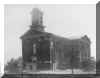
    St. Michael Catholic church was at 21 Pius Street. It was deconsecrated and demolished about 1960 
  • From the St. Michael (South Side) Baptismal Records 1866-1878, p. 136, 2nd section: “Franz Joseph, born 19 Oct 1873; baptized 2 Nov 1873; father: Robertus Ohnsaat; mother: Leopoline Sallinger; sponsors: Joseph Weizenhefer, Josephine Höbel. Father Ignatius.” 
  • From the St. Joseph (Mount Oliver) Baptismal Records 1870-1880, p. 145: “Louisam Cath., born 2 Dec 1875; baptized 12 Dec 1875; father: Roberto Ohnsent, Prussia; mother: Leopoldino Sollenger, Baden; sponsors: Joseph Heirenhäfer, Maria Sherene.”

    St. Joseph Catholic church was at 438 Ormsby Avenue. It was deconsecrated and demolished in the late 20th Century. 
  • No record of the marriage of Joseph Ohnsat or of his children's baptisms at St. Michael, St. Joseph (Mt. Oliver), Sts Peter & Paul (East End), or St. Philomena. The only record found was a baptism for Catherine in 1899. Since she was identified as Lutheran prior to conversion, it is most likely that her parents’ marriage did not take place in a Catholic parish. From the St. Philomena (Pittsburgh) Baptismal Records 1895-1908, p. 97: “Catharinam Christinam Dorothea, born 15 Jul 1879; baptized 16 Apr 1899; father: Josepho Onshat, Grüben Falkenberg, Prussia; mother: Elizabeth Rothamel, Grossalmerade, Hessen-Cassell; sponsor: Rosa Crenner. Note in record: newly converted from Lutheranismo, conditional baptismal. Step-father's name Elliott.”
Since this letter, I've been contacted by another descendant of the Elliott family. This contact provided a great deal of fresh information about Joseph Ohnsat, who died in Pittsburgh PA in 1880.

The letter continued...
From the two marriage records, I gleaned the location of Grüben Falkenberg, Prussia for the Ohnsat family and of Baden for the Salinger family. Using catalogs made available on the internet by the Church of Latter Day Saints, I found Church Registers of Grüben in Kreis (county) Falkenberg, a county in the Schlesien district of Ostpreußen (East Prussia). 
The photo shows typical “Sunday clothes” of 19th-Century Schlesien.
Grüben is a small town of about 500 residents today. It is within about 30 miles of the town of Neisse, and within ten miles of the Neisse River. Since the Prussian empire broke up in the early Twentieth Century, and since the eastern borders of Germany were changed numerous times around WW II, the area now is in the south-central part of Poland. The town is named Grabin in Polish, and its county seat is now named Niemodlin. It is in the Polish state of Opole.
I have reviewed the Church Registers of Grüben, and the handwriting in the volumes is very hard to read. With the help of a transcription service, I have identified my 2nd great grandparents (and your great grandparents) : Franz Ohnsat (b. about Jan 1803) and Catharina Scholz (b. about Aug 1806). Catharina’s family name may have been “Schotz,” since the handwriting in the Church Register is somewhat illegible. Franz and Catharina were married in Grüben on 15 Nov 1831. They had seven children I know of: Franz Josef (b. 13 Mar 1833), Johann Robert (b.18 Sep 1835), Franz Anton (b. 10 Dec 1837), Maria Caroline (b. 8 Jul 1840), Joseph August (b. 3 Jul 1842), Carl Anton (b. 13 Oct 1844), and Johann Heinrich (b. 2 Apr 1847). I have not researched the Church Registers for marriages or deaths of these children, so I cannot guess whether only your grandfather and one grand uncle emigrated to the U.S.
Also according to the Church Registers, the father of Franz Ohnsat was Joseph Ohnsat, who had died by the date of Franz’ wedding to Catharina Scholz. Catharina’s father was Johann Scholz, a farmer. Both families were from Grüben, as were the unrelated witnesses to the marriage of Franz and Catharina. By their stated occupations, Johann Scholz owned a fair amount of farmland, but Joseph Ohnsat owned a smaller parcel.
I was contacted recently by a researcher whose 3rd Great Grandmother Johanna Juliana Scholz is a sister to my 2nd Great Grandmother Catharina Scholz. This researcher lives near Heidelberg Germany, and they are familiar with the area of Grüben, as well as other areas of Germany where I pursue research.
At least with online phone directories, there are no German families with the name Ohnsat today. The family name has several variant spellings in the Church Registers, including Ohnsatt, Ohnsath, and Ohnesat. Other variant spellings may include Ohnezeit and Ohneseit, which are more common names in today’s Germany than the spelling Ohnsat. I have contacted several researchers with the names Ohneseit and Ohnezeit, but they have not returned e-mails to date.
I found the European home of your grandmother also: Breisach am Rhein, in Kreis Breisgau-Hochscwarzwald, in the state of Baden (today Baden-Württemberg).
Breisach am Rhein is on the eastern bank of the Rhein River, at the extreme southwestern corner of today’s Germany. The county that surrounds the town shares borders with France and Switzerland. The county population is about 243.000 residents, and the town itself has 8,644 residents.
I have reviewed the Church Registers of Breisach am Rhein, and the handwriting in the volumes is a bit easier to read than the Grüben records. I have identified my 2nd great grandparents : Georg Salinger and Katherina Vogel. I have not found their marriage record yet, but I have found four of their children: Carl Julius (b. 26 Mar 1833), Anton Herrmann (b.21 Jun 1836), Maria Anna Josepha (b. 21 Mar 1838), and Anna Maria Leopoldina (b. 30 May 1839). I have not researched the Church Registers for marriages or deaths of these children, so I cannot guess whether only your grandmother emigrated to the U.S.
I have researched the Ohnsat family in the U.S. by reviewing censuses of the last twenty years of the 19th Century.
  • In the U.S. Census of 23 Jun 1880, the Robert Ohnsat family lived in Bloom township of Osborne county, Kansas. Robert gave his age as 45 and said he was born in Prussia. His wife Leopoldina gave her age as 34 and said she was born in Baden. Their children’s ages were given as 6 for Frank, 4 for Louiza or Louise, and 2 for Barney. Their neighbors then included the families of Nicholas ARNOLDY, Peter SIMEON, John ARNOLDY, Philip SCHROEDER, Martin OTTLEY, Peter REINERT, Franz RIEDEL, Frank BORDEN, Nicholas RHEINHART, and Nick GASPER. 
  • In the Kansas Census of 1 Mar 1885, the family reported ages of 49 for Robert, 45 for Leopoldina, 11 for Francis, 9 for Louisa, and 6 for Barney. None of the children had attended school within the year, but none were reported as illiterate either. Robert reported owning 320 acres, which were fully in use as farmland, with a value of $1200 for the land and $70 for farm implements and machinery. 50 acres were sown in wheat, 11 in corn, 8 in oats, 0.5 in Irish potatoes, and 1 in millet. He had 150 bushels of corn on hand and 200 bushels of wheat. He had cut 9 tons of prairie hay in 1884.He had sold $5 worth of eggs the previous year, and had made 200 pounds of butter. His livestock included 4 horses, 6 milk cows, 13 other cattle, and 13 swine with a total value of $24. He had 112 peach trees and 6 cherry trees. He had one dog. 
  • The U.S. Census of 1890 was lost due to a fire in a storage area, which was destroyed in 1921. Of the millions of detailed questionnaires completed for the Eleventh Census of the United States, taken in June 1890, only a fragment of the general population schedules and an incomplete set of special schedules enumerating Union veterans and widows are available today. All the records of Kansas were lost. 
  • In the Kansas Census of 1 Mar 1895, the family reported ages of 59 for Robert, 56 for Leopolina, 21 for Francis, 19 for Louisa, and 16 for Bernhart. Only “Bernhart” had attended school within the year, but none were reported as illiterate either. Robert reported owning 320 acres, all “under fence,” of which 100 acres were in cultivation, with a value of $3000 for the land and $75 for farm implements and machinery. 25 acres were sown in wheat, 50 in corn, 5 in oats, 1 in Irish potatoes, and 1 in sorghum for forage or seed. His plans for the next year were 40 acres wheat, 100 acres corn, 8 acres oats, 2 acres Irish potatoes, 5 acres millet, and 1 acre Kaffir corn. He had 200 bushels of wheat on hand. He had cut 25 tons of prairie hay in 1884.He had sold $12 worth of eggs the previous year, and had made 200 pounds of butter. His livestock included 9 horses, 4 milk cows, 60 other cattle, and 53 swine with a total value of $366. He had 2 apple trees and 1 peach tree, and 0.25 acre vineyards; artificial forested area was 1 acre honey locust and 9 acres other varieties. He had one dog.
I have relatively little information about two of the three children of John Robert and Leopoldina Ohnsat. Could you review the information here for you and your brothers and sisters, and help me fill in the missing data?
The letter continued for another four pages, filled with information about Alice's parents, uncles, and aunts. Since they lived into the 20th C, I will provide the information only by private email to family members.
© Thomas G. Kohn, 2013.

2012-06-01

The Ohnsat mysteries on the National Road

Catheritne Ohnsat-Bulthaup told me a family story that my great-grandfather John Robert Ohnsat took his family by Conestoga wagon from Pittsburgh, Pennsylvania to Tipton, Kansas in 1877. Her story was not detailed. It did not tell why the family made the 1100-mile move, why Tipton was the chosen destination, nor how difficult was the trip.

The Ohnsat Family in the United States

John Robert Ohnsat (known in our family as Robert) was born 18 September, 1835 in what was then called Grüben, East Prussia, in the province of Silesia (Ostpreußen, Schlesien, Kreis Falkenberg; today named Graben, Niemodlin county, Opole province, Poland/Polskie). He was baptized in the Catholic church there two days later. At age 36, he emigrated with his brother Joseph, who was about 30. They both immigrated to the United States and lived in Pittsburgh, Pennsylvania from about 1872. It is possible other members of the family also emigrated, as the family name appears for a few years in the Detroit area.


Robert was identified as a butcher in the City Directories of Pittsburgh PA (in publications dated 1872-73, 1876-77, and 1877-78); he lived at 135 Nineteenth, East Birmingham in 1872.

Robert married Leopoldine Salinger (b. 29 May 1839, Deutschland, Baden-Württemberg, Kreis Breisach-Hochschwarzwald, Breisach am Rhein) on 26 November 1872 at St. Michael Catholic Church by Father Fredericus with witnesses Joseph Ohnsat and Jacob Müller. Leopoldine emigrated from Breisach am Rhein, Baden-Württemberg probably in the early 1870s, perhaps with her sister Anna Maria Josephine and brother Anton Hermann. A family anecdote says that she was a nurse in an insane asylum, and that the experience there was so harsh that she made her children promise neither to become nurses nor to allow their children to do so. Robert became a naturalized citizen on 7 February 1873 in the Court of Common Pleas, Pittsburgh, Allegheny county.

Two children were born in Pittsburgh: Frank Robert on 19 October 1873 and Louise Katherine on 2 December 1875. Around the time Louise Katherine was born, the family moved to 75 Seventeenth, S.S. —perhaps this is Shady Side—as reported in the 1876 city directory. Then, within the next year or so, they moved to Brownsville Road, Mt. Oliver, 27th ward, according to the 1877 city directory.

Sometime in 1877, when Robert was 42 and Leopoldina was 38, they resettled to Kansas. Their third child Bernard O. was born near Tipton Kansas in April 1878. Soon after their arrival, John Robert bought land in Bloom township, in the southeast corner of Osborne county, Kansas. The family is entered in the 1880 U.S. Federal Census of Osborne county, Kansas as the "Robert Ohnsol" family that included Leopoldina (wife, age 31), Frank (son, 6), Louiza (daughter 4), and Barney (son, 2).

The gently rolling, rocky land is more suited to cattle grazing than crop farming. Robert died on the ranch as a result of being kicked by a horse, four days short of his 62nd birthday, in 1897. His widow Leopoldine lived on the ranch for a short while and then lived with her daughter Louise, who had married a neighbor boy, John Michael Kohn. Her granddaughter Isabella Kohn (Sister Edna Louise) remembered Leopoldina's fretting that her children just wanted her land and her money. She died in 1919 from dropsy (probably a cerebral stroke) at age 80.

The brother who emigrated with Robert was Joseph Ohnsat (born 3 July 1842). He also lived in Pittsburgh and worked also as a butcher on Larimer Avenue near Broad Avenue. Joseph died in 1880, as a result of being struck by a metal piece that flew from a tanning factory he was walking by, leaving a wife Elisabeth and children Charles (age 6), Dorothea (5), and Catherine (1). The widowed Elizabeth married Matthew Elliott within a few years, and the children were adopted by him. Others have researched this line. Another brother Carl Anton (born 13 October 1844) may have emigrated to live in or near Detroit, Michigan; however, more research is needed to verify that he is the same person as the husband Charles Ohnsat to Helena Kauf and father of Mary Ohnsat-Bargo (1875-unknown), Annie H. Ohnsat-Priemer (1884-1920), Martha Ohnsat (1891-unknown), and Charles J Ohnsat (1893-1960). 

The National Road

The National Road was envisioned to provide a paved roadway from Washington DC first to Wheeling, West Virginia and then, with Congressional direction in 1825, to St. Louis, Missouri. The National Road construction continued from 1806 until 1839, up to Vandalia, Illinois, some 65 miles short of its planned terminus.

The road construction reached Wheeling WV in 1816, and construction in Ohio, Indiana, and Illinois occurred roughly simultaneously. In Ohio, the completed road reached Columbus in 1833 and Springfield in 1838. Surveying in Indiana was being completed in 1827, construction was begun to the east and west from Indianapolis IN, and construction was completed in Richmond IN in 1834. The State of Indiana funded the completion of its part of the road through 1850. The Illinois segments were left as hardened clay, in part because of a lack of stone and for a greater part because of the cessation of federal funding.

The National Road.was most active from the 1830s to the 1860s. The traffic was especially heavy in the 1840s. "Stage coaches and freight wagons contended for running room with families traveling in Conestoga wagons, people walking, snappy carriages, hand drawn carts, hand pushed carts, and improvised vehicles beyond description." [Harry G. Black, Pictorial America: The National Road, 1984, HMB Publications, Hammond IN.]  Various sources estimate the speed of travel between 7 and 15 miles per day, depending on the mode of travel. The stage coach lines traveled as fast as 110 miles in a day. [Black cites a published schedule, "The Mail Pilot Line leaves Columbus for Wheeling daily at 6 a.m., reaching Zanesville at 1 p.m. and Wheeling at 6 a.m. next day, through in 24 hours, allowing five hours repose at St. Clairsville."] During this period, way stations, inns, taverns, hotels, and stage liveries enjoyed a great influence on local and interstate trade. Locals could often see as many as 20 coaches in a row on the road.

Following this active period, use of the National Road diminished with the rise of the railway systems. Rails were set to Wheeling from the east by 1853. [Norris F. Schneider, The National Road: Main Street of America, 1978, Ohio Historical Society, Columbus OH.] The Illinois Central line arrived in central Illinois near East Dubuque in 1855, and the transcontinental railway was authorized in 1862.[3] These two milestones indicate the quick growth of the railways that supplanted the National Road. By the 1870s, several train routes were laid from the eastern states into the plains states. However, most routes followed short-run schedules that required several train changes for a long interstate trip.

Little of the original National Road route is evident today, because the individual states turned their attentions elsewhere and the road fell into ever greater disrepair. Where I live in Dayton OH, some road remnants are visible but not celebrated. A small bridge exists in the Englewood Reserve park, an inclined stretch of road leads up from Taylorsville Reserve to Vandalia, a crossing of canal locks has earthworks remaining, and the ruins of bridge abutments are visible near the Great Miami River and Stillwater River.

By 1870, parts of the road had become little more than a country road in stretches. Beginning in 1925, federal funds were allocated for the building of U.S. Highway 40, which generally follows the path of the National Road. The surveying of the National Road was a solid foundation for the purposes of U.S. 40  Many bridges were replaced, earthworks were removed or expanded, and the filigree of the National Road was stripped away. From Washington PA through St. Louis MO, the 1960s routing of Interstate 70 followed the National Road, and the construction further obliterated remaining vestiges of the National Road.

Few of the hotels, inns, taverns, and stage houses still exist. I have begun to search for guest registers that might include the Ohnsat family. However, their supposed travel by Conestoga wagon—or, more likely, by the wagon called a "Prairie Schooner"—could have made such overnight accommodations unnecessary or infrequent.

Many questions arise about the family's resettling to Kansas, and these are the Ohnsat mysteries on the National Road.
  • Why did Robert decide to leave Pittsburgh in 1877, at age 42, when he was apparently well established as a butcher?
  • When exactly was the trip begun? Logically, it could have started in the Spring, or perhaps as late as September 1877, when Leopoldina might have known she was pregnant.
  • How did the family choose Tipton as their goal? Were advertisements published or books for sale in Pittsburgh that encouraged settlement in Tipton or Kansas in general? 
  • Were any tracts of land available along the path of the National Road in Indiana, Illinois, Missouri, or eastern Kansas?
  • Was land still available in Kansas from the federal Land Grant program?
  • Did Robert bring any cash that would allow him to set up his home and purchase land? 
  • Why did Robert decide to drive a wagon instead of using the railways? Rail travel was available through at least Abilene and west of Salina.
  • What was the cost in 1877 of a Conestoga wagon and team of horses or a Prairie Schooner and a team of oxen?
  • What would need to be packed for the trip by wagon? 
  • Would the wagon mean only occasional need to stop in an inn or hotel? Would there be need to stop for a mid-day meal, and to leave the evening meal at the time of stopping for the night, with breakfast before setting off the next morning?
  • What was the condition of the National Road in 1877-78? (Contemporary plat maps of Ohio and Indiana show that roads did exist from Wheeling WV through St. Louis. The contemporaneous plat maps for Indiana I have found so far are not detailed to parcel owners, but only to township divisions, and do not clearly indicate any road-worthiness of the route.)
  • What is revealed about the route by plat maps of detail for Indiana, and any type of maps for Illinois, Missouri, and eastern Kansas?
  • What was the time needed for the trip? I guess that easy routes could be traveled at 15 miles per day, or more on long days of summer. Unpaved roads likely were the rule in Missouri and Kansas, and average speed would be slower because of rains and ruts after the rains.
An interesting historical footnote is that the closest town to the Robert Ohnsat ranch is Tipton, Kansas. It lies about 10 miles to the northeast of the Ohnsat ranch, in the southwestern corner of Mitchell county and was originally named Pittsburgh. The name was chosen about 1871 because its founder was named Pitt, and the spelling of "burgh" was taken from the spelling of the Pennsylvania city. However, the name Pittsburg was already in use by another town in Kansas, some 120 miles to the southeast. In deference to clarity for the mail system, the town fathers decided to change the name to Tipton, although the town is still situated in Pittsburgh township.

© Thomas G. Kohn, 2013, revised 2014.05.08.

2012-05-03

Letter in answer to a distant Ohnsat relative

I recently met a very distant relative on Facebook. We are related through my grandmother Louise Ohnsat.(1875-1959) and her brother Frank Ohnsat (1873-1962). When she found we were related, she asked about the family history. This is my first reply.


Hi,
I have a lot of bits of a story. Perhaps the bits we put together can tell more.

First, my grandmother Louise Ohnsat died when I was almost 8 years old. I have a few memories of her, but her death and burial are what really stick in my head—not in any bad way, but it was my first observation of what death means. She died at age 83, I guess from heart failure or a stroke. She wasn't hospitalized, but was at home bedridden with a lot of my aunts in attendance. (My mother—a daughter-in-law—was a registered nurse, and a daughter—Sr. Edna Louise—was also a nurse who specialized in pediatrics.) I think she lingered a few days before death took her. She lay in the front bedroom, my grandfather slept on a sofa in the next room. The house was always dark and quiet then, even with a bustle of family members.

Grandpa and Grandma lived in a very small town, Tipton Kansas. There was no funeral home there, and Grandma was laid out for a while in her bed. Then when a casket was bought from Osborne a few miles away, she was laid out in the gym of the local Knights of Columbus hall, which was also a practices and game location for the nearby Catholic high school. Grandma's coffin was set up in front of the stage, and several rows of wooden chairs arced around the coffin and dim lamps that the undertaker had brought in for the rosaries and votive. After the funeral mass and burial, we returned to the hall for a dinner, which the whole town of Tipton attended, including many of my Ohnsat relatives.

I didn't know the Ohnsats very well, except for a few 2nd cousins who lived in Tipton and Beloit Kansas. (They are grandchildren of my Grandma's brother Frank Ohnsat (1873-1962).) Many, many years later I heard that Grandma's brothers Frank and Ben did not get along. There was some dispute among them, perhaps about their father's land (Robert Ohnsat, 1835-1897), and each accused the other of being untrustworthy and money grubbing. I bet that there was a bit of truth there, but also some source of longstanding sibling rivalry that finally burst to the surface, perhaps to the point of neither brother talking to the other.

Ben Ohnsat (1878-1948) married a neighbor girl, Cecelia Riedel (about 1883-about 1950), about 1903 and moved to Garden City Kansas, some 150 miles away. They had one daughter, Josephine, in 1904. Josephine married Joseph Jeremiah Ohmes (1899-1981) about 1922, and they had 14 children. I've been told that many of the children were deaf and needed to learn sign language at a boarding school. (I've not been in touch with any members of this family, so the information is at best second-hand. However, I do have all the children's names and birth and death dates at least through about 1995.)

I hope you can provide some information about your grandfather Francis Ohnsat (1917-1976) and his wife Mille Wiese (the name I have for her at least, 1920-1995). He was among several of the children of your great-grandparents Frank Ohnsat (1873-1962) and Appolonia Streit-Ohnsat (1883-1947) who moved from Kansas to California, generally in the 1930s. Among them were

Anna Marie (1902-1994) and husband August Arnoldy (1889-1961) of Yuba City
Mary Isabelle (1904-2000) and husband Alex Simeon (1904-1981) of Orange County
Robert Charles Ohnsat (1912-1937) of Marysville CA
Matilda Barbara (1915-1998) and husband Victor Stoffel of Fallbrook CA and/or Anaheim
Alice Marie (1925-) and husband Leo Waldman (1915-) of Anaheim.

I visited Alice perhaps 8 years ago, during one of the spring breaks we used to spend in Palm Springs CA.

-o-

My great-grandfathers John M. Kohn (1839-1919) and Robert Ohnsat owned fairly large amounts of land very close to each other in southeastern Osborne County Kansas. The land there has rocky, rolling hills and little rain. Very little of the area is tilled for crops, and the large expanses of native grass are best for cattle grazing. My aunt told me of annual cattle drives that she would see her grandfather starting out, either to drive them all the way to Kansas City (about 250 miles east) or --more likely-- to a railway siding where the cattle were loaded for transit to Kansas City. Their land is about equidistant from the county seat of Osborne and the German community of Tipton. I think the families seldom went to Osborne for supplies and social activities. Instead, they drove wagons to Tipton, about 9 miles away, where they felt at home with the older part of the community who also had a common heritage and language.

Land and its inheritance split many families, I think. My grandfather inherited his father's land, though I guess that he arranged a buy-out of the ownership of his 2 brothers' and 2 sisters' rights. I believe the inheritance occurred to everyone's satisfaction, even though Grandpa Mike (1879-1965) was not the eldest son. The eldest was Peter Kohn (1877-1941), and next were Kate Kohn-Gasper (1881-1955) and Annie Kohn-Streit (1882-1956), then Ben Kohn (1884-1955). All lived in the Tipton area, and I believe all on farms, but the original Kohn land was not split among them. I guess the same happened in the Ohnsat family. Perhaps Ben felt he was cheated on the value of the property; perhaps he was hurt that the land wasn't divided among the three of them.

Maybe you have some information to add here?

Tipton Kansas was settled by many German families from about 1870 through 1880. Though my grandfather spoke a few words of German, his primary language was English, but he had a slight German accent. My father retained even less German, perhaps a vocabulary of 50 words only. Maybe you can tell me whether there is or was a strong German community in Yuba County, which might have persuaded some of the family to settle there. There are also some extended Kohn cousins who also live the region.

Quickly I'll answer some of your other questions:

The Ohnsat family is indeed German, and they likely came from around Paderborn in the central-northeast part of Germany. However, the family I have records for so far is that of Franz Ohnsat (1803-perhaps 1870) and his wife Catharina Scholz (1806-perhaps 1870). They lived in what is now Poland, near the Neisse River, in a very small town named Grabin (today) or Grüben (then). I suspect they were part of a settling of the area while Prussia was building its empire, and that the move was temporary, tied to political pressures and economic encouragements. While they lived there, their citizenship was either Prussian (Preußen) or East Prussian (Ostpreußen).

At least two brothers of the family emigrated to the USA around 1870-1872. They were greatgrandfather John Robert Ohnsat and his brother Joseph August (1842-1880). They both lived in Pittsburgh PA through 1880. Robert married there and brought his family to Kansas between 1875-1878. Joseph married Elizabeth Rothamel (1848-perhaps 1915) there, had three children, and "He was walking down the street in East Liberty next to a tanning factory when a worker threw a piece of scrap metal out the window striking Joseph in the head. He died a day later from a fractured skull," according to contemporary newspaper reports. I've been in touch with his great grandson Larry.

The name has always been a close variant of Ohnsat, with occasional spellings of Ohnsatt and Ohnsaht in baptismal records. I too thought that Onstat, Onstott or Onstodt might be a possibliity, as that name occurs in some Pennsylvania records of unrelated individuals.

I know nothing about the Thompson seedless grape story you refer to. Perhaps your family in California has been involved in grape farming?

I know very little about your grandmother Millie. I beleive that the Social Security data includes her as "MELLADENE H OHNSAT 30 Apr 1920 22 Apr 1995 (not specified) (none specified) 429-18-9616 Arkansas" so she lived in Arkansas when she first registered for Social Security withholding from her employment. I have no other information, so this may not be her. However, I have assumed that Arkansas is her state of birth.

My data shows your father was one of 4 brothers and 1 sister (Robert, Michael John, Jim, Rick, and Donna Marie). Since I have no marriage information for your grandparents, I guess that they were all born approximately 1935-1945. I don't know who are your parents; I have only a husband for Donna Marie, Roger Baker.

I hope you can relate some of the family stories.