Showing posts with label Arnoldy. Show all posts

2013-11-13

Houston County, Minnesota—local development


First publication 2013.11.15. © Thomas G. Kohn, 2013.

As part of southeastern Minnesota, the county is in the “Driftless Zone,” which is marked by the absence of glacial drift[8] and presence of bedrock cut by streams into steep hills. The plateau that surrounds Caledonia includes flat, fertile farm land and hilly, verdant pasture land.

Figure 10. Mississippi transportation, undated.
Navigation up and down the Mississippi encouraged growth of the county (Figure 10). Records of river transport document shipping from as early as 1844. The shipping season typically opened in April, after the river is free from ice. In 1855, a ferry from La Crescent to La Crosse was licensed. Named the “Wild Kate,” it operated without a regular timetable from its normal berth at La Crosse (Figure 11). Two horses powered a treadmill for the crossing. An unreliable steam ferry named “Honey Eye” soon replaced Wild Kate. However, its steam engines had little capacity, and often the ferry “had to tie up to an island, let the steam go down, take off the safety valve, and with buckets fill the boiler, then get up steam again and finish the trip.”[9] After two years of such service, the ferry was abandoned and another company provided better service through 1878.

Figure 11. Mississippi ferry at Redwing, about 1900.
Railroad companies were provided bonds for building by the Minnesota Supreme Court in 1857, in the face of popular and legislative opposition. However, referenda and laws were passed that obstructed state bonds for railway development through 1860. Although the battle over state funding of railway building raged until 1881, the private companies began to install their lines. “A part of the great St. Louis and Minneapolis line runs through the county north and south near the Mississippi River. Another road runs in the valley of the Root River east and west, connecting with the Mississippi road at the river. The third railroad in the county is the ‘Caledonia and Mississippi,’ which, from the junction on the river, follows up the Crooked Creek in a northerly direction to Caledonia, the shire town, where it deflects toward the south, and passes through Spring Grove, and thence on to Preston, its present terminus. This line was undertaken by local enterprise and is of the standard narrow gauge.”[10]

Figure 12. Harvesting flax.
It is possible that John Reinert brought tools of his trade with him to pioneer America, where there would be a ready market for both linen thread and cloth. This hypothesis may be hard to prove, since tax records have not been found to date. Writing in 1882, Neill reported that flax cultivation had begun with one acre in 1878, which produced four bushels of seed.[11] Even through the 20th Century, Minnesota was one of several states that devoted many acres to flax.[12] Flax had become competitive in northern states like Minnesota because these states need fast maturing, cool season crops. Flax can be planted in April, as soon as the soils begin to warm, and it can be harvested in August (Figure 12), well before early frosts.[13] However, since about 1970, American flax production has failed to compete with imported textiles, whether as raw materials or as finished goods. The plat maps of 1931[14] report that neighboring farms to the Reinert home had cattle, hogs, chickens, and geese. An average 120 acres of each farm supported the livestock with grain and pasture.

The county population grew quickly in the 1860s, decreased slightly from 1900 to the 1930s, and gradually grew to the 2010 population of 19,000.[15] The town of Caledonia has grown steadily, although slowly. La Crescent growth began only in the middle of the 20th Century, and its growth has been the driver of county growth since then. Of the other villages and townships, only Spring Grove village, Houston village, and La Crescent township have 1000 residents or more. The remaining 19 villages and townships have not grown much beyond populations of 500 each.

Figure 13. Root river in Houston county.
The Root River and its broad floodplain (Figure 13) divide the county into a north third and a south two-thirds. In the north are the villages of Money Creek (unincorporated), Pine Creek (unincorporated), Houston (population 979 in 2010), Hokah (population 580), and the largest town of the county, La Crescent (population 4,830). La Crescent overlooks the Mississippi floodplain and slow-moving river, almost directly west from La Crosse, Wisconsin. South along the Mississippi are the towns of Brownsville (population 466) and Reno (unincorporated).

The southwestern two-thirds of the county populate the rolling plateau above the Mississippi. Caledonia (population 2,868) sits in the center. The other towns on the plateau are Yucatan (unincorporated, township population 351), Sheldon (unincorporated, township population 289), Black Hammer (unincorporated, township population 326), Riceford (unincorporated), Newhouse (unincorporated), Spring Grove (population 1,330 and Spring Grove township population 422), Wilmington (unincorporated, township population 472), Eitzen (population 243 and Winnebago township population 257), and Freeburg (unincorporated, Crooked Creek township population 323).

Figure 14. Map of Caledonia, 2001.
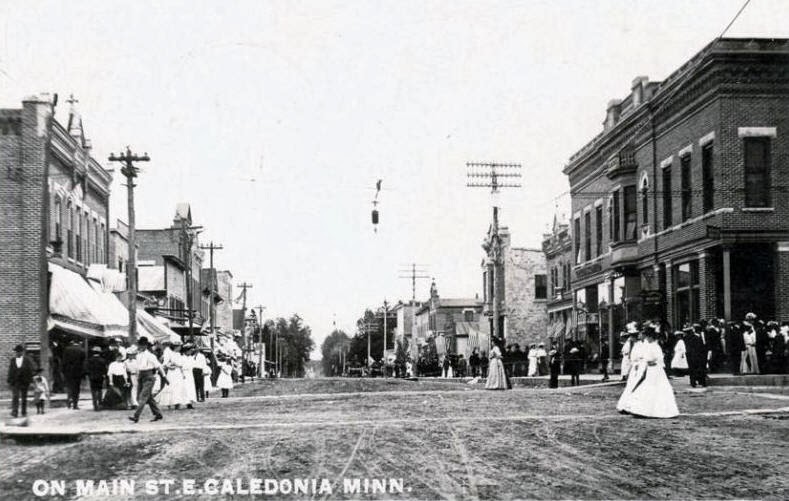
The town of Caledonia is a typical American small town (Figure 14). The streets are broad and mostly planned in a matrix of parallels and right angles. The businesses form a tightly-knit downtown that has stood for one hundred years or more (Figure 15). The largest buildings in Caledonia are the county courthouse, which was built in the 1890s, and St. Mary Catholic church, which was originally built in the 1880s. Both are located in the southern central area of town, within a few blocks of each other. The brick or stone buildings that date from before 1885[16] have weathered well, although some façades have received incongruent modernizations. A line of newer businesses skirts the western edge of town along Highway 44-76.


Figure 15. Caledonia downtown, 1907.
The homes developed clearly in separate additions: a few frame homes from the end of the 19th Century still stand, a group of homes built in the 1920s occupies one section of town, more modest homes built after the Great Depression are in another pocket, and in several groupings are the homes built to house the smaller families that formed after soldiers returned from World War II. Here and there, you can find homes built in the 1960s through the 1990s that fill in vacant lots left during the other periods of development. Along State Route 44-76 are the most recent businesses that include gas stations, motels, fast food, and restaurant-bars. The nearest city for movies and other entertainment is seventeen miles away: La Crosse, Wisconsin.[17]

Previous sections: Background for family history, Parish
Next sections: History, Reinert History in the Area, Travel to Kansas in 1872, Tipton KS, Seguin KS, La Crosse WI

Notes

8

See Coulee Region, accessed 2013.10.22.

9

Neill, p. 285.

10

Neill, p. 258 (writing in 1882 about the Chicago, Milwaukee and St. Paul company).

11

Neill, p. 292.

12

378,000 acres in 1920 Minnesota, 1.6 million acres in 1943, and diminishing lately to only 10,000 acres, as cited in a Minnesota farms publication.

13

Thomas Jefferson Agricultural Institute, in their online essay on flax.

14

Unattributed, Atlas and Farmers’ Directory of Houston County,. Webb Publishing Company (St. Paul MN), 1931. Personal copy available as scanned images.

15

Population figures cited in Wikipedia's article on Houston county and linked entries for each township and town.

16

Neill, p. 271.

17

Nine years after Susanna Reinert had left the Caledonia area for Tipton, Kansas with her mother, sisters, and brothers, she moved to La Crosse with her husband John M. Kohn and three children. They had moved there at the encouragement of her brother-in-law Mathias Kohn, who had owned and operated a well-respected and successful saloon and boarding house in La Crosse since 1864.

2013-10-21

Pioneers who Resettled from Caledonia MN to Tipton KS

© Thomas G. Kohn, 2013.

Although the John Reinert family lived in Houston county, Minnesota only five years (1867 to 1872), their life there should have left some records. I've begun further research for these items.
  • School attendance for Nicholas (age 16 through perhaps 18), Peter (ages 14 through perhaps 18), Mary (ages 7 to 12), and Gertrude (ages 6 to 8)
  • Burial of Johann Reinert
  • Confirmations of Nicholas and Peter, possibly Mary and Gertrude
  • Lease agreements for the farm property
  • Tax forms for 1868 through 1872
  • Auction notices and receipts for the small property that could not fit in a wagon
I found a news item and advertisement in the Houston County Journal of 25 June 1872 that must have piqued their interest.
Buffalo Land.
We are in receipt of this new and most agreeable volume of over 500 pages from the press of E. Hannaford & Co., (Publishers of First Class Subscription Books, Cincinnati and Chicago) The author is Hon. W. E. Webb, of Topeka, Kansas, long and widely known from his connection with the interests of emigration, and a strikingly original and jocular humorist.

He describes the wealth and wonders, the mysteries and marvels of the boundless West—that wild region so much talked about, yet as little understood, whose growth and development seem like a tale of Eastern magic. It is superbly illustrated, containing no less than fifty-three original and striking engravings, from actual photographs and designs by Prof. Henry Worrall, and executed (the enterprising publishers assure us) at a total cost of over $2,800.
In a short review like this, it is, of course, impossible to convey a perfect idea of this admirable work. To any one who has the least touch of “the Western fever,” it must prove really invaluable; and for all classes of readers, without execution, it is the liveliest and most laugh-provoking book we have seen for many a day. It abounds with valuable information, the reliability of which is vouched for by Governor Harvey, of Kansas, and others. It fairly brims over with wit and humor, and many of its chapters rival Mark Twain’s happiest style.
“Buffalo Land” embraces a wide and varied range of topics, among them the following:
Details of great interest and importance concerning the natural features, vast resources, rapid development, and almost incredible progress of the far Western States and Territories, with glimpses of their mighty future;
Curious and interesting facts connected with the climatic and other changes consequent upon the settlement and denser population of the newly-reclaimed Western lands;
Fresh and authentic information, from official sources, respecting the supply of fuel and lumber available for use on the Great Plains: the cost of a farm, what the emigrant should bring with him, stock-raising at the West, &c.
A full summary of the Homestead and Preemption laws and regulations, prepared by a former Register of the U.S. Land Office.
Full and accurate descriptions of the habits, characteristics, etc., of the savage red man, buffalo, elk, antelope, etc., as found in their native wilds and on the out-skirts of civilization;
Graphic and thrilling narratives of hunting adventures, stalking the bison, encounters with Indians, etc.;
Vivid pictures of life on the frontiers; the past and present of the Great Plains; the vast inland sea, and the marvelous animal life with which it once teemed;
Highly interesting accounts of the geological wonders of the West, antiquarian and scientific researches, etc.
The publishers desire agents for everywhere, allowing exclusive territory and the most liberal commissions. The firm is a prompt and reliable one. We give their address in full: E. Hannaford & Co., 192 West Madison Street, Chicago, Ills. Many of our readers will want this book, and agents will make money rapidly in its sale.The book created excitement among residents of the county.
A couple Houston county residents travelled to Kansas and returned to verify many of the claims made in Buffalo Land. In September 1872, Nicholas Arnoldy liquidated his business, and with his brothers Michael, Peter, and Chris formed a wagon train. Katherine decided to join about a dozen other families who left for Tipton KS. These families included the Schwinden and Palen families, among others.

Katherine Reinert and her family of five children (Susanna, Nicholas, Peter, Gertrude, and Maria) arrived in Tipton after a trip of 600 miles or more. Although a family document asserts the travel was by wagon, travel on the Mississippi River seems more logical to some landing down river. St. Donatus, Davenport, or Burlington in Iowa or Hannibal or St. Louis in Missouri are possible locations for the transition to a wagon, . Their arrival in Tipton is indirectly documented in the parish history of St. Boniface.

They came from Caledonia, Minnesota, in the fall of 1872. The names of those families are: Nick Arnoldy, Sr., Peter Jacobs, Franz Jergen [tgk correction: Mergen], Matt Ellenz, William Swinden, Nick Gasper (single), Philip Schroeder, John Beck, John Elser, Mike Cordel, John Cordel, and Mrs. Catherine Reinert. Before the families arrived, Mr. Peter Jacobs had been sent, earlier in the same year, to inspect the territory. These families were followed by many others, and by 1879 the number of families had increased to seventy. "

 The St. Boniface history lists the family names, though it doesn't clarify that all had come from Caledonia:
H. Konzem
F. Mergen
P. Jacobs
J. P. Cordel
M.J. Arnoldy
Mrs. Catherine Reinert
Michael Cordel
Frank Cordel
Nicolaus Gasper
Anton Gasper
August Richter
Frank Boden
Peter Arnoldy
Nicolaus Arnoldy, Jr.
Conrad Arnoldy
John S. Arnoldy
Peter Gengler
Peter Krier
Philip Schroeder
Henry Streit
Theodor Arens
John Arnoldy, Sr.
Ignatz Hake
John Bach
Bernard Thummel
Dominic Schulte
John Scheer
Carl Henneboehle
John Beck
Carl Braun
John Stroh
Joseph Fischer
Jacob Pauly
Matthias Ellenz
Matthias Eck
John Endres
William Fueser

Relevant Links

2012-05-03

Letter in answer to a distant Ohnsat relative

I recently met a very distant relative on Facebook. We are related through my grandmother Louise Ohnsat.(1875-1959) and her brother Frank Ohnsat (1873-1962). When she found we were related, she asked about the family history. This is my first reply.


Hi,
I have a lot of bits of a story. Perhaps the bits we put together can tell more.

First, my grandmother Louise Ohnsat died when I was almost 8 years old. I have a few memories of her, but her death and burial are what really stick in my head—not in any bad way, but it was my first observation of what death means. She died at age 83, I guess from heart failure or a stroke. She wasn't hospitalized, but was at home bedridden with a lot of my aunts in attendance. (My mother—a daughter-in-law—was a registered nurse, and a daughter—Sr. Edna Louise—was also a nurse who specialized in pediatrics.) I think she lingered a few days before death took her. She lay in the front bedroom, my grandfather slept on a sofa in the next room. The house was always dark and quiet then, even with a bustle of family members.

Grandpa and Grandma lived in a very small town, Tipton Kansas. There was no funeral home there, and Grandma was laid out for a while in her bed. Then when a casket was bought from Osborne a few miles away, she was laid out in the gym of the local Knights of Columbus hall, which was also a practices and game location for the nearby Catholic high school. Grandma's coffin was set up in front of the stage, and several rows of wooden chairs arced around the coffin and dim lamps that the undertaker had brought in for the rosaries and votive. After the funeral mass and burial, we returned to the hall for a dinner, which the whole town of Tipton attended, including many of my Ohnsat relatives.

I didn't know the Ohnsats very well, except for a few 2nd cousins who lived in Tipton and Beloit Kansas. (They are grandchildren of my Grandma's brother Frank Ohnsat (1873-1962).) Many, many years later I heard that Grandma's brothers Frank and Ben did not get along. There was some dispute among them, perhaps about their father's land (Robert Ohnsat, 1835-1897), and each accused the other of being untrustworthy and money grubbing. I bet that there was a bit of truth there, but also some source of longstanding sibling rivalry that finally burst to the surface, perhaps to the point of neither brother talking to the other.

Ben Ohnsat (1878-1948) married a neighbor girl, Cecelia Riedel (about 1883-about 1950), about 1903 and moved to Garden City Kansas, some 150 miles away. They had one daughter, Josephine, in 1904. Josephine married Joseph Jeremiah Ohmes (1899-1981) about 1922, and they had 14 children. I've been told that many of the children were deaf and needed to learn sign language at a boarding school. (I've not been in touch with any members of this family, so the information is at best second-hand. However, I do have all the children's names and birth and death dates at least through about 1995.)

I hope you can provide some information about your grandfather Francis Ohnsat (1917-1976) and his wife Mille Wiese (the name I have for her at least, 1920-1995). He was among several of the children of your great-grandparents Frank Ohnsat (1873-1962) and Appolonia Streit-Ohnsat (1883-1947) who moved from Kansas to California, generally in the 1930s. Among them were

Anna Marie (1902-1994) and husband August Arnoldy (1889-1961) of Yuba City
Mary Isabelle (1904-2000) and husband Alex Simeon (1904-1981) of Orange County
Robert Charles Ohnsat (1912-1937) of Marysville CA
Matilda Barbara (1915-1998) and husband Victor Stoffel of Fallbrook CA and/or Anaheim
Alice Marie (1925-) and husband Leo Waldman (1915-) of Anaheim.

I visited Alice perhaps 8 years ago, during one of the spring breaks we used to spend in Palm Springs CA.

-o-

My great-grandfathers John M. Kohn (1839-1919) and Robert Ohnsat owned fairly large amounts of land very close to each other in southeastern Osborne County Kansas. The land there has rocky, rolling hills and little rain. Very little of the area is tilled for crops, and the large expanses of native grass are best for cattle grazing. My aunt told me of annual cattle drives that she would see her grandfather starting out, either to drive them all the way to Kansas City (about 250 miles east) or --more likely-- to a railway siding where the cattle were loaded for transit to Kansas City. Their land is about equidistant from the county seat of Osborne and the German community of Tipton. I think the families seldom went to Osborne for supplies and social activities. Instead, they drove wagons to Tipton, about 9 miles away, where they felt at home with the older part of the community who also had a common heritage and language.

Land and its inheritance split many families, I think. My grandfather inherited his father's land, though I guess that he arranged a buy-out of the ownership of his 2 brothers' and 2 sisters' rights. I believe the inheritance occurred to everyone's satisfaction, even though Grandpa Mike (1879-1965) was not the eldest son. The eldest was Peter Kohn (1877-1941), and next were Kate Kohn-Gasper (1881-1955) and Annie Kohn-Streit (1882-1956), then Ben Kohn (1884-1955). All lived in the Tipton area, and I believe all on farms, but the original Kohn land was not split among them. I guess the same happened in the Ohnsat family. Perhaps Ben felt he was cheated on the value of the property; perhaps he was hurt that the land wasn't divided among the three of them.

Maybe you have some information to add here?

Tipton Kansas was settled by many German families from about 1870 through 1880. Though my grandfather spoke a few words of German, his primary language was English, but he had a slight German accent. My father retained even less German, perhaps a vocabulary of 50 words only. Maybe you can tell me whether there is or was a strong German community in Yuba County, which might have persuaded some of the family to settle there. There are also some extended Kohn cousins who also live the region.

Quickly I'll answer some of your other questions:

The Ohnsat family is indeed German, and they likely came from around Paderborn in the central-northeast part of Germany. However, the family I have records for so far is that of Franz Ohnsat (1803-perhaps 1870) and his wife Catharina Scholz (1806-perhaps 1870). They lived in what is now Poland, near the Neisse River, in a very small town named Grabin (today) or Grüben (then). I suspect they were part of a settling of the area while Prussia was building its empire, and that the move was temporary, tied to political pressures and economic encouragements. While they lived there, their citizenship was either Prussian (Preußen) or East Prussian (Ostpreußen).

At least two brothers of the family emigrated to the USA around 1870-1872. They were greatgrandfather John Robert Ohnsat and his brother Joseph August (1842-1880). They both lived in Pittsburgh PA through 1880. Robert married there and brought his family to Kansas between 1875-1878. Joseph married Elizabeth Rothamel (1848-perhaps 1915) there, had three children, and "He was walking down the street in East Liberty next to a tanning factory when a worker threw a piece of scrap metal out the window striking Joseph in the head. He died a day later from a fractured skull," according to contemporary newspaper reports. I've been in touch with his great grandson Larry.

The name has always been a close variant of Ohnsat, with occasional spellings of Ohnsatt and Ohnsaht in baptismal records. I too thought that Onstat, Onstott or Onstodt might be a possibliity, as that name occurs in some Pennsylvania records of unrelated individuals.

I know nothing about the Thompson seedless grape story you refer to. Perhaps your family in California has been involved in grape farming?

I know very little about your grandmother Millie. I beleive that the Social Security data includes her as "MELLADENE H OHNSAT 30 Apr 1920 22 Apr 1995 (not specified) (none specified) 429-18-9616 Arkansas" so she lived in Arkansas when she first registered for Social Security withholding from her employment. I have no other information, so this may not be her. However, I have assumed that Arkansas is her state of birth.

My data shows your father was one of 4 brothers and 1 sister (Robert, Michael John, Jim, Rick, and Donna Marie). Since I have no marriage information for your grandparents, I guess that they were all born approximately 1935-1945. I don't know who are your parents; I have only a husband for Donna Marie, Roger Baker.

I hope you can relate some of the family stories.