Angelina Russo-Iacano was the matriarch of the Iacano family in Cleveland, Ohio.
Militello Rosmarino, Sicily
Angelina was born Angela Russo Femminella 2 October 1895 in Militello Rosmarino, Messina
Province, Sicily, Italy.
 |
| Militello Rosmarino (red pin) in Italy |
The
Province of Messina (Italian:
Provincia di Messina;
Sicilian:
Pruvincia di Missina) is in the autonomous island region of
Sicily in
Italy, located in the north of the island. Its capital is the city of
Messina. The province was redesignated as the
Metropolitan City of Messina in 2015.
 |
| Militello Rosmarino (red pin) in Sicily |
Sicily (
SISS-i-lee;
Italian:
Sicilia [siˈtʃiːlja],
Sicilian:
Sicìlia) is the
largest island in the
Mediterranean Sea. Officially referred to as
Regione Siciliana (in
Italian, Sicilian Region), the island is located in the central Mediterranean Sea, south of the
Italian Peninsula, from which it is separated by the narrow
Strait of Messina. Its most prominent landmark is
Mount Etna,
the tallest active volcano in Europe, and one of the most active in the
world, currently 10,922 ft (3,329 m) high. The island has a typical
Mediterranean climate.
The earliest
archaeological evidence of human activity on the island dates from as early as 12,000 BC. By around 750 BC, Sicily had three
Phoenician and a dozen
Greek colonies and, for the next 600 years, it was the site of the
Sicilian Wars and the
Punic Wars. Sicily frequently remained Independent while the rest of Italy frequently changed hands after the fall of the
Roman Empire in the 5th century AD. Sicily was ruled during the
Early Middle Ages by the
Vandals, the
Ostrogoths, the
Byzantine Empire, and the
Emirate of Sicily. The
Norman conquest of southern Italy led to the creation of the
Kingdom of Sicily, which was subsequently ruled by the
Hohenstaufen, the
Capetian House of Anjou,
Spain, and the
House of Habsburg, It was finally unified under the
House of Bourbon with the
Kingdom of Naples as the
Kingdom of the Two Sicilies. It became part of Italy in 1860 following the
Expedition of the Thousand, a revolt led by
Giuseppe Garibaldi during the
Italian unification, and a plebiscite. Sicily was given special status as an autonomous region after the
Italian constitutional referendum of 1946.
Messina Province
 |
| Militello Rosmarino in Messina Province |
The province of Messina has an area of 1,261 sq mi (3,266 square km) and
had in 2014 a total population of 647,477. The province includes the
Aeolian Islands, all part of the comune of
Lipari (with the exception of
Salina). There are 108
comuni (singular:
comune) in the province, and much of the population is concentrated in the coastal area, after the
hill towns had been largely abandoned from the 19th century. The territory is largely mountainous, with the exception of alluvial
plain at the mouths of the various rivers. The largest plain is that in
the area between
Milazzo and
Barcellona Pozzo di Gotto. Rivers of the province include the
Alcantara and the
Pollina, which forms the border with the
province of Palermo to the west. The main mountain ridges are the
Peloritani, up to 1,300 metres (4,300 ft) in elevation, and the
Nebrodi, up to 1,900 metres (6,200 ft), which are included in a Regional Natural Reserve.
 |
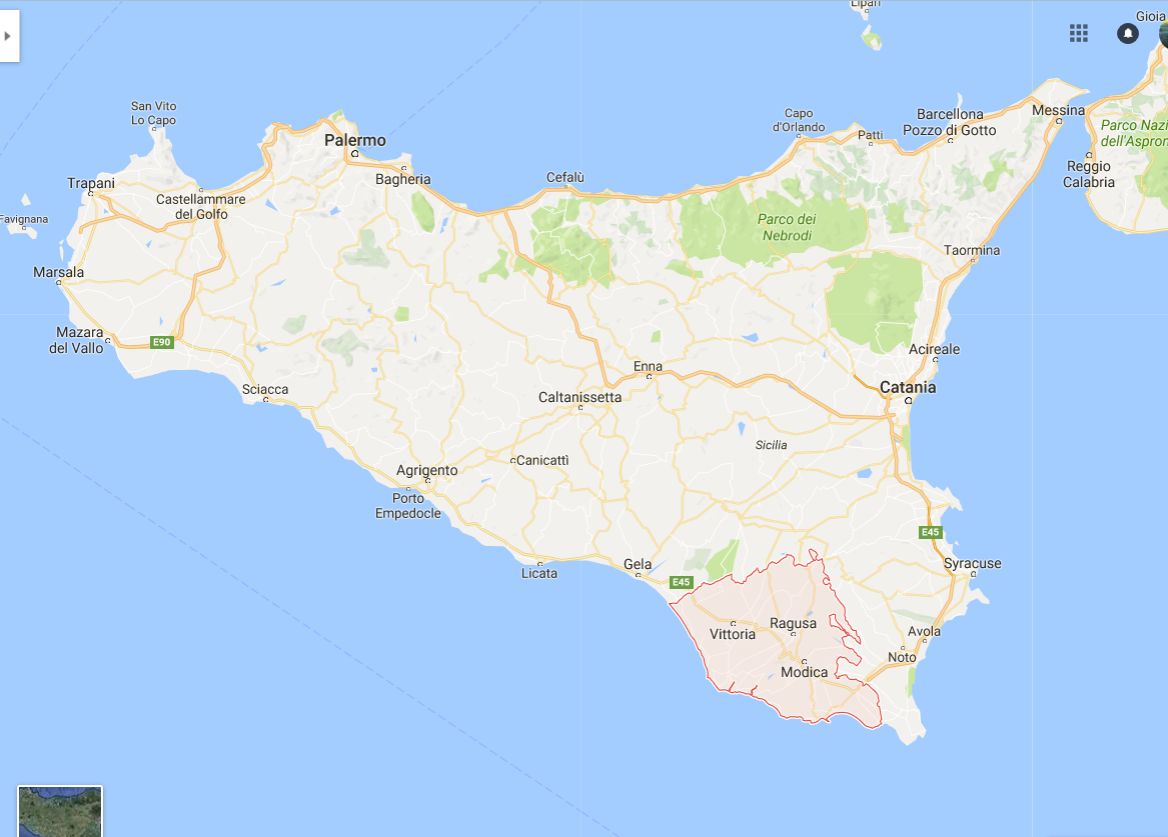
| Messina Province (pink boundary) |
The Messina coastline is
approximately 131 mi (211 km) long, measured along the Autostrada A18 (76 km south from Messina) and A20 (135 km west from Messina). Along the Messina coast are many
fishing villages such as
Giardini-Naxos,
Letojanni,
Forza d'Agrò,
Sant'Alessio Siculo,
Santa Teresa di Riva,
Furci Siculo,
Roccalumera,
Nizza di Sicilia,
Alì Terme,
Villafranca Tirrena,
Spadafora,
Oliveri,
Gioiosa Marea,
Piraino,
Brolo,
Capo d'Orlando,
Sant'Agata di Militello,
Acquedolci,
Caronia, and
Santo Stefano di Camastra. The
Hyblaean Mountains dominate the north of the province and its highest peaks are
Monte Lauro,
Monte Casale and
Monte Arcibessi. The rivers of the province are the
Irminio,
Dirillo and
Ippari and the only lake in the province is the
Lago di Santa Rosalia along the course of the Irminio river. The area is mostly unspoiled, as the 19th century and
early 20th century saw large migration from Ragusa to the more
prosperous areas of Italy and abroad.
 |
| The region controlled by Militello Rosmarino (pink boundary) |
Of the 108
Comuni of the Province of Messina, the largest are
Messina (population 246,951),
Barcellona Pozzo di Gotto (41,157),
Milazzo (32,600),
Patti (13,241),
Sant'Agata di Militello (13,026),
Capo d'Orlando (12.928),
Taormina (10,909), and
Lipari (10,782).
Sant'Agata and Militello Rosmarino History
Two settlements were found near Sant'Agata di Militello along the ancient shore line that date back to the Upper Paleolithic: San Teodoro and Scordoni.
Civilization has been almost uninterrupted until the bronze age (1400-1300 BC). At that time, continued incursions by belligerent forces from the Italian peninsula attempted to establish villages. Excavations in Scurzi have shed light on the ceramic arts, melters and scallops that contributed to the spinning and weaving economy of those people. This settlement died out around 400 BC. However, some of the region's villages remained active beyond 200 BC.
[I am continuing to translate detailed history from
http://www.militellum.net/Storia.htm.]
(I'm sorry that my ability to read the entry is not very good. I am handing it to an online service to try another's eyes at it.)
The Iacano Family Through the 1940s
marriage was performed by E. Raia (or Raca) on 21 June 1914. The photos
of the certificate do not include this date, which was provided in the
returned marriage license. Perhaps the certificate identifies the church
as well.
he Grandparents' next census entry, in 1930, enumerates them at 2565
East 114th Street, Cleveland. The family consists of the members John
(age 49), Angelina (36), Frances (17), Rose (13), Frank (11), Jim (10),
Jennie (8), and John (6). The youngest son, Joe (4) is enumerated on the
next census page.
Web translation of http://www.militellum.net/Storia.htm
There
are numerous ruins of Roman occupation.
With the destruction of the Roman Empire, this territory, which is
pertinent to landfills, where it continues to exist for agricultural
purposes, was interested in its proximity to the coast and the main
coastal path, from the military and economic events that will lead to a
progressive aggregation in Interned houses and the establishment of the
Byzantine-Greek element.
The Norman conquest of Sicily, from the first incursions to the
definitive subjection, lasted about thirty years (1060-1091). On Norman
arrival, the inhabitants of these lands felt free from Arab oppression.
The story of Militello Rosmarino is the story of great events and
authentic characters, of a laborious, educated, fearful God of God. A
slow but gradual story that in the subtlety of research and in the
acceptance of many friendly advices has its own Thought that is
certainly of classical origin
”
.
There are two etymological explanations of Militello, according to the
interpretation of the Topographic Dictionary of Sicily of Vito Amico.
The first is mythological and refers to the strong and belligerent
character of the inhabitants.
The etymological root "Militum tellus" refers in fact to an urban
agglomeration built by soldiers who, after the death of Archimedes,
escaped from Syracuse, settled in the hilly territory above what will
later become S.Agata.
The second hypothesis, he wants Militello to take his name from the rich
and flourishing honey production of the land (melis tellus).
However, it is also possible to trace a third interpretation, which
specifically refers to the conquest of Sicily by the Normans, who were
already ordained in Calabria. Coming to Sicily, the latter, probably
wanted to repeat the toponyms of the two Calabrian cities to their
worst, that is, Mileto and S.Marco of Calabria, ending to name two of
the cities of Messina respectively S.Marco d'Alunzio and Miletellum (
Small Mileto).
Rocco Pirri, in his work "Sacred Sicily", appoints the "civitates et
castella", assigned by Gran Conte Ruggero between 1081 and 1082, to the
Diocese of Troina; Among them, he also identifies Miletum.
In 1197-98, in the "Sicilian Sacred" of the Diocese of Messina, the
lands belonging to it are listed, again Miletum appears.
From the news reported, we note that Militello is always named next to
S.Marco and as in 1082 and 1198, it was called Mileto and in 1176,
Militello. Militello's quote also appears in the Acts of the Aragonese
Chancellery.
There is little news we have about the first centuries of Militello's
life, for the lack of documents.
From the "Magnun Capibreve" by Giovan Luca Barberi, we learn that
Militello, at the time of the Normans and the Swabians, was certainly a
state-owned land, that is to say under the direct dependence of the
Crown.
Under the Aragonese, Militello became a feudal land and the first to be
invested, was the country's ruling Gania's Sancho militia. He had the
Lordship, but having become a traitor, all good was confiscated.
Militello passed, around 1320, to Sancho d'Aragona, the illegitimate son
of King Frederick II. From the marriage of the latter, two children
were born, one of them, Federico, Count of Cammarata, father's property
was confirmed and the baronate of Militello and St.Marco was renewed in
1335. He married Giovanna d'Auria who gave To light two children,
Sanciolo and Vinciguerra.
The first of these, married Lucia Palizzi, from whom Matteo was born,
who died without offspring, which is why his brother Vinciguerra (1364)
succeeded him.
Vinciguerra d'Aragona, certainly one of the most interesting figures of
the Middle Ages in Sicily, was a great supporter of Frederick III who
had much to do in the direction of the Kingdom. In 1371 the land was
reconfirmed with the castle of Militello.
In the Militello government, son Federico, rational teacher, was born in
Vinciguerra, Lord of S.Marco and his ranches, Longi and S. Brother and
captain of Alcara's life. He was among the barons who revolted at King
Martino I's time and for this reason his possessions were confiscated,
but it seems that with an act of clemency, on October 10, 1396, Martino I
had reconfirmed the concession of Brother Brother, Mirto and Alcara,
Even though some sources (Friend, De Spuches) agreed that Frederick, who
was away from his land, died of exile.
Archival sources document as in September 1400, Martino I, wanting to
end the rebellion of his subjects and reward the services rendered to
the state, wanted to grant the land of Militello to Bernardo di Caprera,
who, with the approval Directed, exchanged him with Enrico Rosso -Gran
Chancellor of the Reich-receiving the feud of Monterosso.
The Rosso family of Conti d'Aidone, a descendant of Red Ugon, son of
Altavilla, headed for Militello throughout the fifteenth century, with
the title of baronate, having the power of "mere and mixed empire"
(civil and criminal jurisdiction ) And all the real rights of Guglielmo,
niece of Damiano Rosso, for 60 in April 1442.
Pietro Ponzio, son of William, was invested in 1455 by the baron of
Militello, Cerami and Pardo, retaining his rights until death.
His son Enrico succeeded in getting his investment on April 18, 1505;
This captain of arms, for various cities of the Kingdom in the year
1480-1484 and 1499, as a regent on behalf of his father, resided at that
time in Militello and he is due to an administrative fervor that finds
in the promotion of construction and artistic, significant and
Unexpected start towards a new urban development process, its most
explicit manifestation.
In 1508, at the death of Henry, he was invested by the son of Girolamo
Rosso of Militello's baron, and in these he succeeded in 1515, Vincenzo
Girolamo, who died without descendants. Thus, after more than a century,
the Lady of Rosso at Militello ended.
In 1536 the messenger Antonio La Rocca acquired the title of baron and
took possession of the lands and the castle of Militello for himself and
his descendants; A few years later he acquired the "mere and mixed
empire". Baron, lands and castle passed to Giovanni del Carretto count
of Racalmuto, spouse of the daughter of Vincenzo Girolamo Rosso, who
remained a widow. The Count, in the name of his wife, redeemed Filippo
La Rocca the barony, the land and the castle of Militello, giving the
title and the goods, without ever having invested, to Girolamo Gallego
and Rosso in 1573, born of the union of John Gallego and Angela Red.
Fr. Girolamo's son and Margherita Requisens, Vincenzo Gallego was
invested in the 1600's of the Militello lordship. To these, promoters,
together with the mother of the Dominican convent (1615), turned to the
Navy's naturalists to seek protection from frequent pirate attacks,
after that in 1580, eight cormorant galleys landed on the beach and
plundered each Which had deported many inhabitants, slaughtered in
slavery, in Africa.
It was Luigi, born of Don Vincenzo and Donna Francesca Giambruno, who
succeeded her father, to obtain in 1628 the "mere and mixed imperium"
and the faculty of building a castle at the Marina. This, which was
built on the existing towers, created the conditions for quickly and
quickly building a settled reality (S.Agata) at the coast, which is now
more secure and therefore interested in productive activities and trade
routes. At the tower there was a cargo, a carpentry, and some
fishermen's houses.
Engineers and military architects offered a picture of the situation of
the coastal towers at the end of the sixteenth century and urged the
strengthening of the tower, making for the first time the place of the
old papers.
However, the Gallegos showed that they had even bigger prospects.
In the
seventeenth century, Vincenzo and Luigi Gallego sought and obtained
permission to build a large palace next to the towers, obtaining for the
family the title of "Marquis of S.Agata" and then of princes (1658).
Luigi was still granted the populist license by King Philip IV (1657) to
promote in the same site the foundation of a village, a real urban
settlement on which the future development of the town will be based.
The information from "Riveli" shows a greater degree of agility, due to
the success of breeding silkworm and the production of oil and wine.
The feudal economy was still based on rights, property, gabelles,
censors, customs, duties.
Luigi died on September 19, 1662, one day before the premature death of
his son Vincenzo, born of the union with Anna Spadafora. Then, in Louis,
succeeds Brother Girolamo, according to Prince of Militello, in 1664,
who died without heirs.
The state of Militello, therefore, passed to his nephew Vincenzo (1678).
His brother, Gaetano, succeeded in 1693, who was the fourth prince of
Militello and marquis of S.Agata.
In 1722, the state of Militello passed to Giuseppe, the fifth prince of
Militello and Marquis of S.Agata, then to his son Francesco Paolo
(1755), and again to his son Giuseppe (1777).
The last Prince of Militello was Don Giuseppe Gallego Naselli, who in
1815 had been involved in political processes, accused of belonging to
Carboneria.
In 1821, to cope with his debts, he had to surrender all his feuds and
also the Castle to Prince Don Giuseppe Lanza Branciforte of Trabia and
Butera, for a lifetime. He was privately owned by any of his
possessions, had to leave his city and move to Naples, where he died
after a few months.
From the examination of the feudal land rivals, existing at the State
Archives of Palermo dated 1584, we can have a fairly clear picture of
Militello's urban situation. They also document that agricultural
activity was widespread at the coast and adjacent hills (vineyards
S.E.A.T., arable land at S.I.P.R.A. and Serrabernardo).
From the Militello Rivals of 1811, the old rights that the population
exercised until the end of feudalism were derived, and that, with the
liquidation of the feudal regime, they were no longer recognized by the
new emerging class.
From these records, it turns out that Militello had a castle with
prisons and warehouses; The documents prove to be unequivocally the
existence of a castle, of which there are, however, no reliable news on
the foundation date, although it is likely that it can be traced back to
the Norman period.
Even in 1787 and 1792, laws had been enacted which envisaged the census
of state lands and their enfiteous concession to the less well-off
classes.
With the Liberal Constitution of 1812, feudalism was abolished, although
it had spontaneously given up these rights, in reality, the feudalists
still benefited.
It was in 1835 that he tried to solve the demagnetic problem; To this
end, Ferdinand II appointed General Visitors to investigate the
agricultural conditions of Sicily and in 1841 another important decree
was issued, which ordered the Intendents to actively collaborate in the
work of the Visitors.
There was a long series of litigation and controversy in all the
Sicilian municipalities, which inevitably came to an end in the
systematic abusive appropriation of communal land by the nascent
bourgeoisie.
Militello's population grew a lot in recent years and from Sicily's
"Journal of Statistics" No. 22 of December 1853, published in Palermo,
we learned that in 1798 Militello had 3520 souls, in 1831 he had 3527
and in 1847, 4003 ( Of which 2800 males and 1203 females).
In 1855, there was the separation of S.Agata from Militello, which made
it autonomous.
Having greatly increased and now being able to express himself in a
municipal identity, S.Agata forwarded, in 1830, an instance of autonomy
to the Government of Naples. However, the required number of inhabitants
was still lacking in order to be brought to the common ground, so the
request was rejected and the Government granted to the town of S.Agata
only an office to receive the acts of the Civil State and later in 1838,
the official who cared for the state Civilian was also tasked with
guarding the annona.
In 1839, despite the lack of numerical requirements to break away from
Militello, the mayor, who had possessions in the hamlet with skillful
diplomacy, made the municipal body of time leap to a resolution
approving the transfer of mandatory prisons and municipal offices from
Militello to S.Agata.
With the transfer of the municipal offices to S.Agata, the geographical
maps were also revolutionized, referring to the fraction as: S. Agata
Militello Messina Valley District of Patti Circondario S. Agata
Militello.
Militello did not silently silence the overthrow and immediately went to
the open rebellion, sending to the General Assembly of 1848 a memorial
explaining his reasons and asking for justice to be made.
Even the nearby commune of Alcara, who was injured by the longest
distance to go to S.Agata, filed a petition to the parliament for the
filing of any document.
Over the years, Militello's situation deteriorated more and more.
While the resource before S.Agata was trade, with the transfer of
municipal offices, the only resource of Militello, the forensic
activity, was to die.
Already in 1840, the municipality's rent was invested in the Navy and
Militello's inter-municipal roads and public buildings began to fall in
ruins.
The Militello municipal authorities, forced to travel far from their
country, began to integrate into the new reality and to slowly, but
gradually detach themselves from their place of origin.
The actual separation between Militello and S.Agata was, therefore,
definitively sanctioned, the legal one, only in 1855.
The estate agent Giuseppe Manso had the task of sharing the territory
between the two municipalities.
S.Agata was now completely removed from Militello; A new page of history
began for the new community.
The predominantly pastoral and agricultural economy typical of the
Nigerian countries found one of the most favorable market opportunities
at the Saint-Raphael rally.
In the coastal strip, where more favorable communications were possible
and on which a small number of small population centers were making use
of the practice of marking girovaga, the implementation of such a large
fair, such as that of S.Agata, provided the possibility Of meeting for
the sale of livestock and the purchase of handicraft and "consumption"
products to the inhabitants of a part of the island that lived in
singular isolation.
Although already for some time an appointment for merchants and buyers
at the castle, in Gaetano Gallego in 1700, had the privilege of setting
up a trade fair in S.Agata.
This appointment became more and more an important moment of exchange,
confirming the growing economic importance of the coast compared to the
feudal centers, which, on the other hand, resented a gradual depletion.
In fact, at S.Agata, they held annual meetings with the traffickers, and
the favorable position provided ever greater luck at the fair.
Moreover, a number of documents belonging to Gallego's homeowners insist
on the antiquity and importance of this market, underlining how
"Always, ab ancient and by those who have no bad memory in the opposite,
a fera in the Marina of S.Agata, which is famous for all this Kingdom”
.
The Barons Gallego had assumed the lordship of Militello in 1573;
Girolamo, son of Don Giovanni Gallego, born of an Aragonese knight and
an Aztec Princess and Castelano of the Savior in Messina, married Angela
Rosso, a descendant of a man who from the time Martini had owned the
town. In 1600 title and property passed on to his son Vincenzo, who in
April 1620 obtained the Royal Curia the mere and mixed empire with the
faculty of making a castle at the towers "?S.Agata di Militello with
regard to the four far removed from the land of a thousand paces, he
called unto him, to fortify their towers than to build, on behalf of the
offense of their parents, and eventual suppression intends proseguía
thou? And she said unto the enemies of our holy faith and the defense of
the ”