John Iacano was the scion of the Iacano family in Cleveland, Ohio.
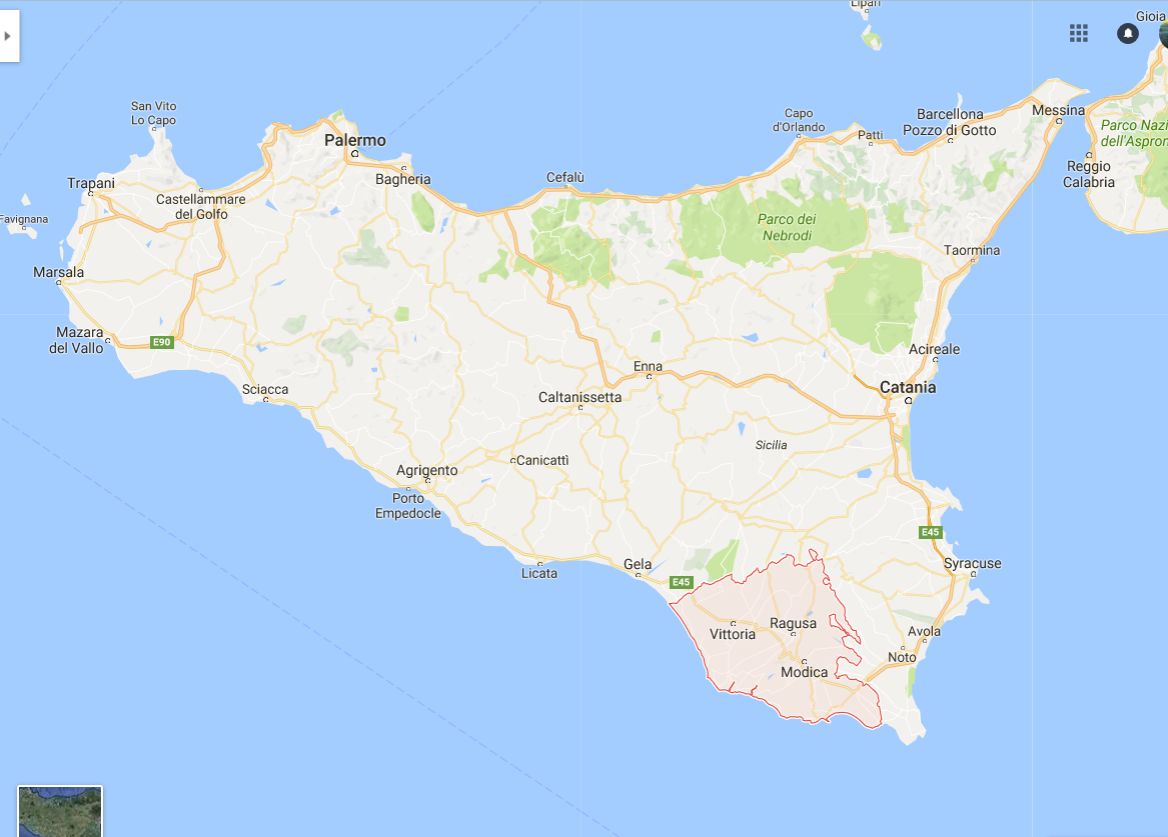
Ragusa, Sicily
 |
| Italy in southern Europe |
John was born Giovanni Iacono (note the different spelling) 21 February
1881 in Ragusa,
Ragusa Province, Sicily, Italy.
The
Province of Ragusa (
Italian:
Provincia di Ragusa;
Sicilian:
Pruvincia 'i Rausa) is in the autonomous region of
Sicily in
Italy, located in the southeast of the island. Its capital is the city of
Ragusa, which is the most southerly provincial capital in Italy.
 |
| Sicily at the south of Italy |
Sicily (
SISS-i-lee;
Italian:
Sicilia [siˈtʃiːlja],
Sicilian:
Sicìlia) is the
largest island in the
Mediterranean Sea. Officially referred to as
Regione Siciliana (in
Italian, Sicilian Region), the island is located in the central Mediterranean Sea, south of the
Italian Peninsula, from which it is separated by the narrow
Strait of Messina. Its most prominent landmark is
Mount Etna, the tallest active volcano in Europe, and one of the most active in the world, currently 10,922 ft (3,329 m) high. The island has a typical
Mediterranean climate.
The earliest
archaeological evidence of human activity on the island dates from as early as 12,000 BC. By around 750 BC, Sicily had three
Phoenician and a dozen
Greek colonies and, for the next 600 years, it was the site of the
Sicilian Wars and the
Punic Wars. Sicily frequently remained Independent while the rest of Italy frequently changed hands after the fall of the
Roman Empire in the 5th century AD. Sicily was ruled during the
Early Middle Ages by the
Vandals, the
Ostrogoths, the
Byzantine Empire, and the
Emirate of Sicily. The
Norman conquest of southern Italy led to the creation of the
Kingdom of Sicily, which was subsequently ruled by the
Hohenstaufen, the
Capetian House of Anjou,
Spain, and the
House of Habsburg, It was finally unified under the
House of Bourbon with the
Kingdom of Naples as the
Kingdom of the Two Sicilies. It became part of Italy in 1860 following the
Expedition of the Thousand, a revolt led by
Giuseppe Garibaldi during the
Italian unification, and a plebiscite. Sicily was given special status as an autonomous region after the
Italian constitutional referendum of 1946.
 |
| Ragusa province, at the south of Sicily |
The province of Ragusa has an area of 623 sq mi (1,614 square kkm) and had in 2001 a total population of 295,264. The Ragusan coastline is approximately 53 mi (85 km) long. Along the Ragusan coast are many fishing villages such as
Kaukana,
Punta Secca,
Marina di Ragusa and
Marina di Modica. The
Hyblaean Mountains are dominating the north of the province and its highest peaks are
Monte Lauro,
Monte Casale and
Monte Arcibessi. The rivers of the province are the
Irminio,
Dirillo and
Ippari and the only lake in the province is the
Lago di Santa Rosalia along the course of the Irminio river. The area is mostly unspoiled, as the 19th century and
early 20th century saw large migration from Ragusa to the more
prosperous areas of Italy and abroad.
 |
| Ragusa province, satellite view |
There are 12
Comunes of the Province of Ragusa., including
Ragusa(population 72,483),
Vittoria (60,918),
Modica (53,448),
Comiso (29,489),
Scicli (25,855), and
Pozzallo (18,393). Some of Ragusa province has changed dramatically, largely due to tourism. However, many places in Ragusa remain
untouched by the last two centuries, and the atmosphere of the 18th
century still pervades them. Industries can be found in the towns of
Ragusa and Pozzallo. The west and south of the province are mainly dedicated to intensive farming in greenhouses and the local vegetables leave from the
Market of Vittoria
to be exported to all of Europe making the province of Ragusa one of
the biggest producers of greenhouse produce. In the areas around Ragusa
and Modica cattle farming is at the highest levels in the region for
milk, dairy and meat production. Tourism seems to have now replaced the fishing industry as the principal source of employment along the coast.
 |
| City of Ragusa, at the center of Ragusa province |
Ragusa is the capital of the
province of Ragusa. The city is built on a wide
limestone hill between two deep
valleys, Cava San Leonardo and Cava Santa Domenica. Together with seven other cities in the
Val di Noto, it is part of a
UNESCO World Heritage Site.The skyline of Ragusa is punctuated by the
towers,
domes and
cupolas of the many exquisite churches for which the
province
is known.
The origins of Ragusa can be traced back to the
2nd millennium BC, when there were several
Sicel settlements in the area. The current district of Ragusa Ibla has been identified as
Hybla Heraea. The ancient city, located on a 980-ft (300-m) high hill, came
into contact with nearby Greek colonies, and grew thanks to the nearby
port of
Camerina. Following a short period of
Carthaginian rule, it fell into the hands of the ancient Romans and the
Byzantines, who fortified the city and built a large castle. Ragusa was occupied by the
Arabs in 848 AD, remaining under their rule until the 11th century, when the
Normans conquered it. Selected as County seat, its first Count was Geoffrey, son of Count
Ruggero of
Sicily.
Thereafter Ragusa's history followed the events of the
Kingdom of Sicily, created in the first half of the twelfth century. A
Chiaramonte family fief, it remained the county capital after it was unified with
Modica in 1296, a status it lost in the 15th century after a popular revolt.
In 1693 Ragusa was devastated by a huge
earthquake, which killed some 5,000 inhabitants. Following this catastrophe the city was largely rebuilt, and many
baroque
buildings from this time remain in the city. Most of the population
moved to a new settlement in the former district of Patro, calling this
new municipality "Ragusa Superiore" (Upper Ragusa) and the ancient city
"Ragusa Inferiore" (Lower Ragusa). The two cities remained separated
until 1926, when they were fused together to become a provincial capital
in 1927 at the expense of Modica, the former capital and the most
populous and important city in the region since 1296.
The Iacono Home

Giovanni Iacono's birth is documented in the civil registers of the community.
Although the entry reveals the family address, 18 Via Scepa Cava, I believe the street has since been renamed or removed by city development.
His parents are documented as Francesco Iacono, age 30 (born 1851), and Francesca Rovetto, age 21 (born 1860).
I presume one of the witnesses, Giovanni Iacono, is his grandfather, age 58 in 1881, and thus born in 1823.
| Transcription |
Translation |
L'anno
milleottocento "Ottantuna", add "ventuno" di "Febbruio". a ore "ante"
meridiane "nove" e minuti "dieci", nella Casa comunale.
Avanti di me "Giambattista Maltipanti assessare unziasco funzianante fut
Sindaco inpedita da" Uffiziale dello Stato Civile del Comune di
"Ragusa" è compars"o Francesco Iacono" di anni "trenta", * "mazzettoce"
domiciliat"o" in "Ragusa", "i"l quale mi ha dichiarato che alle ore
"ante" meridiane "otto" e minuti "tre", del di "d'aggi" del "cuarenti"
mese, nella casa posta in "via Scepa Cava" al numero "dieceotto", da
"Francesca Rovetto sua maglie d'anni ventuno aperacia con epso
convivente" è nato un bambino di sesso "masculisco" che "egli" mi
presenta, e a cui d"a" i"l" nom"e" di "Giovanni".
A quanto sopra e a questo atto sono stati presenti quali tertimoni
"Biagio Luparella", di anni "Septantanune", * "Calzalaio", e "Giovanni
Iacono", di anni Cinquantotto", * "Ferraie", entrambi residenti in
questo Comune.
"Letto il prepessnte otto ogli interveneceti ed investate a
sottasperiverlo diggeso di non safrecce e gi è da me fimato"
"Giambatista Maltipanty" |
In
the year one thousand eight hundred eighty-one on the twenty-first day
of February at nine a.m. and ten minutes, at the community house.
Before me Giambattista Maltipanti, assessor and functionary as Syndoch
of the state civil office of the community of Ragusa has come Francesco
Iacono aged thirty years * florist (?) and resident of Ragusa, who has
told me that today in the current month, at the home on Via Scepa Cava
at the number 18 of his wife Francesca Rovetto twenty-one years of age
with whom he lives was born a child of male sex, and who have given hime
the name Giovanni.
At the time given above and at this place were the witnesses Biagio
Luparella aged seventy-one * shoemaker and Giovanni Iacono aged
fifty-eight * iron worker (?) who are both residents in this community.
Having read this Act to the party and witnesses, they did not contest it
or amend it.
Giambattista Maltipanty" |
| Right Column:
Numero "Trecento Sedici"
"Iacono Giovanni" |
At the right column,
"Number three hundred seventeen
Giovanni Iacono." |
|
|
[missing: baptismal record]
[missing: confirmation record]
Giovanni's 1906 passport leads me to believe that he emigrated that year, when he was 25. Searches in the databases of Ellis Island have not resulted in records that show an Italian Giovanni Iacono immigrant age 25 in 1906.
| Transcription |
Translation |
1369 1
In nome di sua maetà Vittorio Emanuele III
per grazia di dio e per volonté della nazione
Re d'Italia
Passaport rilasciato a Iacono Giovanni
figlo di FaFrancesco
e di Rovetto Francesca
nato a Ragusa
il 21 Febbruaio 1881
residente a Ragusa
in provincia di Siracusa
de condisione masculine (?) |
1369 1
In the name of his majesty Vittorio Emanuele III
through the grace of god and the will of the nation
King of Italy
Passport released by Iacono Giovanni
son of Francesco
and of Rovetto Francesca
born in Ragusa
the 21 February 1881
resident of Ragusa
in the Province of Syracuse
with the condition of masculine (?)
|
Page 2
Connotati del Titolare del Passaporto
Statura m. 1. 65 1/2
Eta anni 25
Fronte Cassn
Occhi crestami
Naso piccolo
Bocca guista
Capelli contorni
Barba reisn
Colorito bruno
Corporatura regr.
Segui particolari H
Firma del Titolare |
Characteristics of the Passport Holder
Height 1.65 1/2 meter (5' 7")
Age 25 years
Forehead __Cassn__
Eyes __crestami__
Nose small
Mouth __guista__
Hair curly
Beard shaven
Coloration brown
Body normal
Notable __Segui__ H (N - none?)
Signature of the Holder |
Page 3
Il presente passaporto e rilasciato per (1) New York
ed e valido (2) per tre anni
(3) Gantuito Ro Secreto
31-1-1901
Moduin 20 Marzo 1906
GlSottoPugett
Seal: Regia Sotto Prefettura del Ci... |
Page 3
The passport is presented and released to (1) New York
and is valid (2) for three years
__Gantuito Ro Secreto__
31 January 1901
Moduin (a location) 20 March 1906
The undersecretary VG
Seal: __Regia Sotto Prefettura del Ci...__ |
An Immigrant in Cleveland
[missing: ship manifest for arrival in New York, Philadelphia, Boston, or New Orleans]

Grandfather's 1910 census entry shows him boarding at 2010 Orange Avenue in Cleveland, along with Giuseppe Tumino and Frank Gesso, who are all Italian immigrants. The address is apparently not shared by the owner of the dwelling. The information corroborates an immigration of 1906. Giovanni has not yet naturalized by 1910.
Family stories relate that John emigrated some ten years before his
marriage, and that he went back to Sicily to meet and accompany Angelina
to the U.S. or provided for the travel with a family member. However,
her family appears in the 1920 Census of Cleveland, and Angelina Russo is documented as an immigrant with two other women from Militello Rosmarino in 1911. These documents may argue against the
stories; the couple may have met in Cleveland.
The Iacano Family Through the 1940s

Our grandparents' marriage license was issued 18 March 1914, and it documents their (joint) address as 1435 Orange Avenue, Giovanni's age 30, and Angela's age 18. Their parents are Francesco Iacono and Francesca "Roetta" for Giovanni and Vincenzo Russo Femminela and Rosa Blogna for Angela.

The marriage was performed by E. Raia (or Raca) on 21 June 1914. The photos of the certificate do not include this date, which was provided in the returned marriage license. Perhaps the certificate identifies the church as well.

Grandparents' wedding photo, 1914.

Our grandparents' 1920 census entry was difficult to find. Though the census enumerator wrote the
family name as "Yadino," the given names and ages corroborate well to
the Giovanni (John) Iacano family at this time. As well, the Orange Avenue address
is corroborated by other documents.
Note that Angelina Russo-Iacano's parents (Vincenzo and Rose Russo) and siblings (Biagio age 22, Joe age 13, Tony age 11, and Caroline age 8) are enumerated only a few lines later. The family after the Russo's is the Barone family, who may have been the family that produced Ralph Cosiano's mother.

The Grandparents' next census entry, in 1930, enumerates them at 2565 East 114th Street, Cleveland. The family consists of the members John (age 49), Angelina (36), Frances (17), Rose (13), Frank (11), Jim (10), Jennie (8), and John (6). The youngest son, Joe (4) is enumerated on the next census page.

The 1940 census enumerates them at the same street but at a different address, 3473 East 114th Street, Cleveland. Aunt Frannie has already married and moved out, and the family consists of John (age 59), Angela (44), Rose (23), Jenny (19, the respondent who was listed first), Frank (21), Jimmy (20), John (14), Joe (13), and Gaetana (3).
Grandfather's death document (dated 30 October 1944) gives the bare essence of the horrible tragedy that claimed his life. He died 22 October 1944 at the "center of [the] meter room, East Ohio Gas Co." The immediate cause of death was "third degree burns with charring and ashing, industrial accident, due to failure of liquid natural gas holders Nos. 3 and 4, with resultant escape of liquid natural gas, followed by fire."
Aunt Frannie provided the details of his vital statistics: resident of Cleveland Ohio at 3473 East 114th Street; widower of Angelina; birth on 21 February 1882 [which should have been 1881] in Ragusa, Italy; parents Vincenzo Iacano and Rosa Blogna, both of Ragusa; and that he was to be buried in Calvary Cemetery by Sam Biondo.
[missing: church register entry for his burial, Calvary Cemetery documentation of the plot location]
.